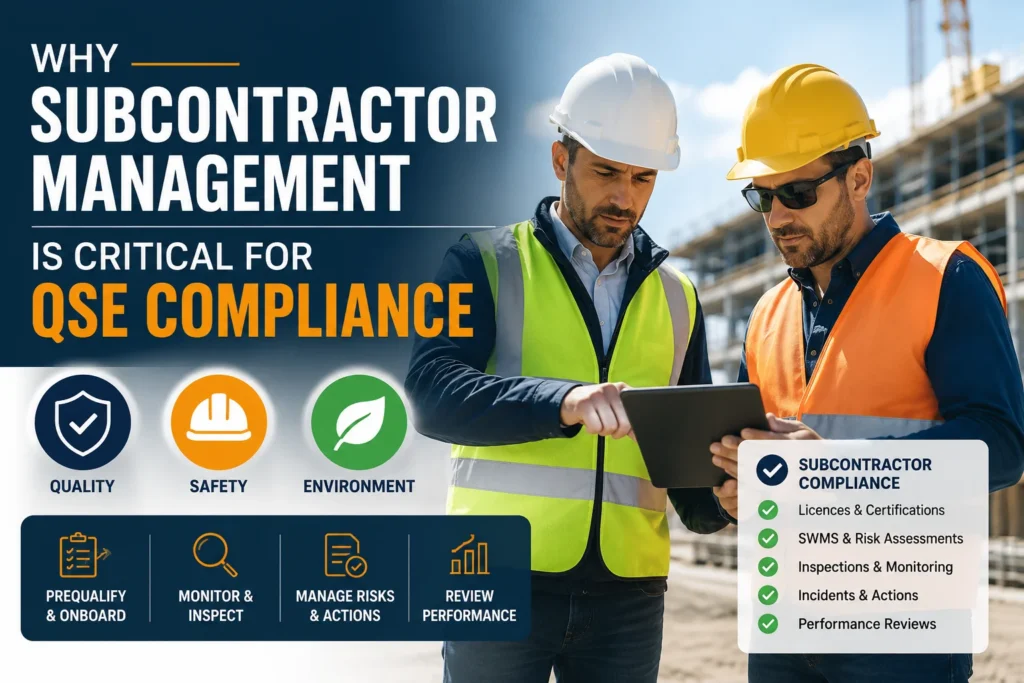
Construction projects rarely depend on one team. They involve subcontractors, suppliers, specialist trades, site crews, and external contractors working together across different locations and stages of a project.
That makes subcontractor management a critical part of QSE compliance.
A project may have strong quality, safety, and environmental procedures internally. However, if subcontractors do not follow the same requirements, gaps can quickly appear. Missing documents, expired licences, incomplete risk assessments, poor site practices, and unresolved corrective actions can all create unnecessary compliance risks.
For construction companies, effective subcontractor management means more than collecting paperwork before work begins. It means continuously checking that subcontractors meet the required quality, safety, and environmental standards throughout the project.
What Is Subcontractor Management?
Subcontractor management is the process of selecting, onboarding, monitoring, and reviewing subcontractors to make sure they meet project and compliance requirements.
A structured process usually covers:
- Subcontractor prequalification
- Licences and certifications
- Insurance and competency records
- SWMS and risk assessments
- Site inductions
- Safety inspections
- Environmental requirements
- Quality inspections
- Incident and non-conformance reporting
- Corrective action management
- Ongoing subcontractor performance reviews
Therefore, subcontractor management connects procurement, project delivery, safety, quality, and compliance into one process.
Why Is Subcontractor Management Important for QSE Compliance?
Subcontractors can perform some of the highest-risk activities on a construction project. They may also work across multiple sites and interact with other contractors.
As a result, the principal contractor or project team needs visibility into what each subcontractor is doing and whether they are meeting the required standards.
In Australia, Safe Work Australia states that multiple PCBUs can share WHS duties and that these duties cannot simply be transferred through a contract. Duty holders must consult, cooperate, and coordinate their activities.
This makes subcontractor coordination an important part of practical WHS and QSE management.
1. It Helps Verify Subcontractor Competency
Before a subcontractor starts work, organisations need to establish whether the company and its workers have the appropriate qualifications, licences, experience, insurance, and competencies.
A proper subcontractor prequalification process can help verify:
- Relevant licences and certifications
- Insurance documents
- Worker competencies
- Previous experience
- Safety records
- Relevant procedures
- Environmental controls
- Quality systems
This reduces the risk of engaging a subcontractor who cannot meet the project’s requirements.
2. It Keeps Risk Assessments and SWMS Under Control
Risk assessments and Safe Work Method Statements (SWMS) should not become documents that are uploaded once and forgotten.
Work conditions can change. Activities can change. New hazards can appear.
Consequently, project teams need a process for reviewing subcontractor documentation and confirming that controls remain suitable.
Safe Work Australia recommends identifying hazards, assessing risks, implementing controls, and regularly reviewing those controls.
3. It Creates Better Visibility Across Multiple Sites
Construction businesses often manage several projects at the same time. Without a central system, subcontractor information can become scattered across emails, spreadsheets, shared folders, and paper forms.
A centralised QSE system can provide a clearer view of:
| QSE Area | What Can Be Monitored |
|---|---|
| Prequalification | Documents, licences, insurance and approvals |
| Safety | SWMS, risk assessments, incidents and inspections |
| Quality | Defects, inspections and non-conformances |
| Environment | Environmental checks and site requirements |
| Actions | Open, overdue and completed corrective actions |
| Performance | Subcontractor reviews and recurring issues |
This makes it easier for managers to identify gaps before they become larger problems.
Subcontractor Management Should Continue After Onboarding
One of the most common mistakes is treating subcontractor compliance as a one-time onboarding activity.
A subcontractor may meet every requirement before starting a project. However, that does not guarantee ongoing compliance.
For example, a licence may expire, a new worker may join the team, site conditions may change, or a previous corrective action may remain unresolved.
Therefore, effective subcontractor management should follow the full project lifecycle:
Prequalify → Onboard → Induct → Monitor → Review → Correct → Reassess
Regular inspections, toolbox talks, site observations, audits, and performance reviews help maintain this cycle.
How Poor Subcontractor Management Creates QSE Risks
Poor subcontractor management can create problems across all three QSE areas.
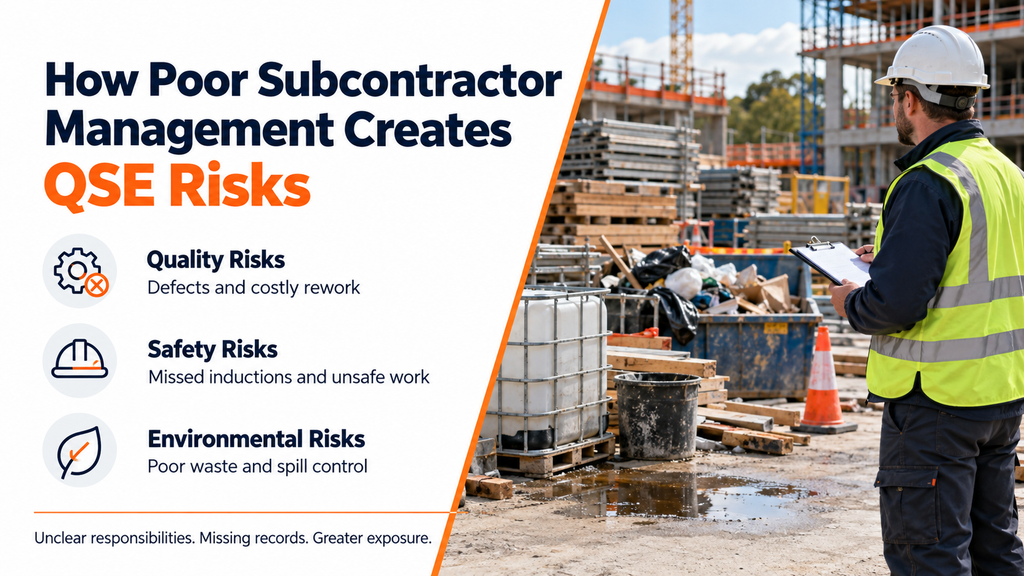
Quality Risks
Poor subcontractor control can contribute to:
- Defective work
- Rework
- Missed inspection points
- Incomplete documentation
- Failed quality checks
- Repeated non-conformances
Safety Risks
Safety gaps can include:
- Missing or outdated SWMS
- Inadequate worker competency
- Uncontrolled hazards
- Poor site housekeeping
- Incomplete incident reporting
- Unresolved safety actions
Environmental Risks
Environmental compliance can also suffer through:
- Poor waste management
- Incorrect material handling
- Pollution risks
- Inadequate environmental inspections
- Failure to follow project environmental controls
As a result, subcontractor management should form part of the organisation’s wider QSE management system rather than operate as a separate administrative process.
What Should a Subcontractor Management System Include?
A practical digital subcontractor management system should make compliance easier for both internal teams and external contractors.
Key capabilities can include:
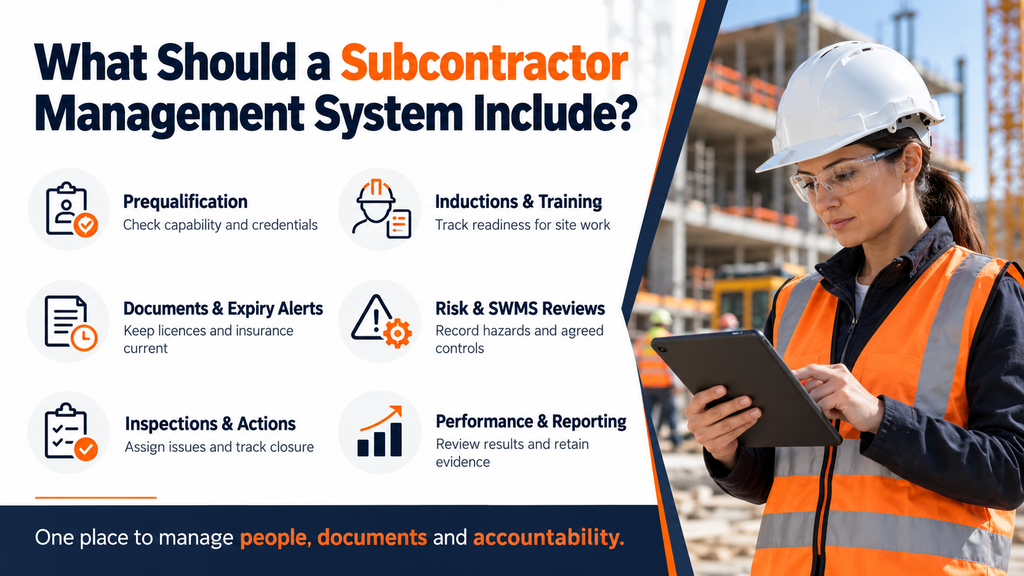
Subcontractor Prequalification
Allow teams to collect and review:
- Company information
- Licences
- Certifications
- Insurance
- Competency records
- Safety documentation
- Other project-specific requirements
Contractor Onboarding
Once approved, subcontractors should receive the relevant project requirements, forms, inductions, and site information.
Ongoing Compliance Monitoring
Instead of waiting for an audit, teams can monitor inspections, documents, incidents, actions, and other compliance activities throughout the project.
Corrective Action Tracking
When a problem is identified, the system should make it easy to assign responsibility, set due dates, attach evidence, and confirm closure.
Performance Reviews
Subcontractor performance can be reviewed using factors such as:
- Safety performance
- Quality outcomes
- Environmental compliance
- Inspection results
- Corrective action closure
- Recurring non-conformances
This gives project managers a more complete picture of subcontractor performance.
How Sky Soft Compliance Supports Subcontractor Management
Sky Soft Compliance is a construction-focused QSE management platform designed to connect subcontractor management with everyday site compliance.
The platform supports subcontractor onboarding, management, allocation, and performance reviews, alongside core QSE workflows such as risk assessments, SWMS, inspections, incident reports, non-conformances, and corrective actions.
It also provides contractor access, allowing subcontractors and external users to interact with relevant forms and processes without giving them unnecessary access to the wider system.
Teams can use features such as:
- Subcontractor prequalification
- Contractor onboarding
- Custom digital forms
- QR code access
- Site inspections
- SWMS management
- Risk assessments
- Incident reporting
- Corrective action workflows
- Multi-project and site visibility
- Branded compliance reports
The result is a more connected approach to managing subcontractors and QSE information across construction projects.
A Simple Subcontractor Compliance Checklist
Before and during a project, construction teams can use a checklist like this:
| Check | Before Work | During Project |
|---|---|---|
| Company prequalification | ✓ | Review |
| Licences and certifications | ✓ | Monitor expiry |
| Insurance | ✓ | Review |
| SWMS and risk assessments | ✓ | Review when work changes |
| Site induction | ✓ | Refresh when required |
| Safety inspections | ✓ | |
| Quality inspections | ✓ | |
| Incident reporting | ✓ | |
| Corrective actions | ✓ | |
| Performance review | ✓ |
This approach helps move subcontractor management from a document collection exercise to an ongoing compliance process.
Better Subcontractor Management Means Better QSE Visibility
Subcontractors are an important part of modern construction delivery. Therefore, organisations cannot treat their compliance responsibilities as ending when a subcontractor signs a contract or completes an induction.
Instead, construction teams need a consistent way to qualify, onboard, communicate with, monitor, and review subcontractors.
When these processes connect with risk assessments, SWMS, inspections, incidents, non-conformances, and corrective actions, QSE teams gain better visibility across the entire project lifecycle.
Ultimately, effective subcontractor management helps construction businesses build a stronger culture of quality, safety and environmental compliance while keeping important evidence organised and easier to access when it is needed.
Frequently Asked Questions
Subcontractors can influence the quality, safety, and environmental performance of a construction project. Effective management helps organisations verify competency, monitor compliance, identify risks, and track corrective actions throughout the project.
It can include company details, licences, insurance, certifications, worker competencies, safety records, relevant procedures, and project-specific compliance requirements.
The appropriate frequency depends on the project’s risks, activities, subcontractor performance, and contractual requirements. High-risk or changing work may require more frequent monitoring and review.
Yes. A construction QSE software platform can centralise subcontractor documents, onboarding, inspections, risk assessments, corrective actions, and performance reviews, making information easier to track across projects.
Sky Soft Compliance provides tools for subcontractor prequalification, onboarding, contractor access, performance reviews, inspections, risk assessments, SWMS, incidents, non-conformances, and corrective actions within a connected construction QSE platform.