
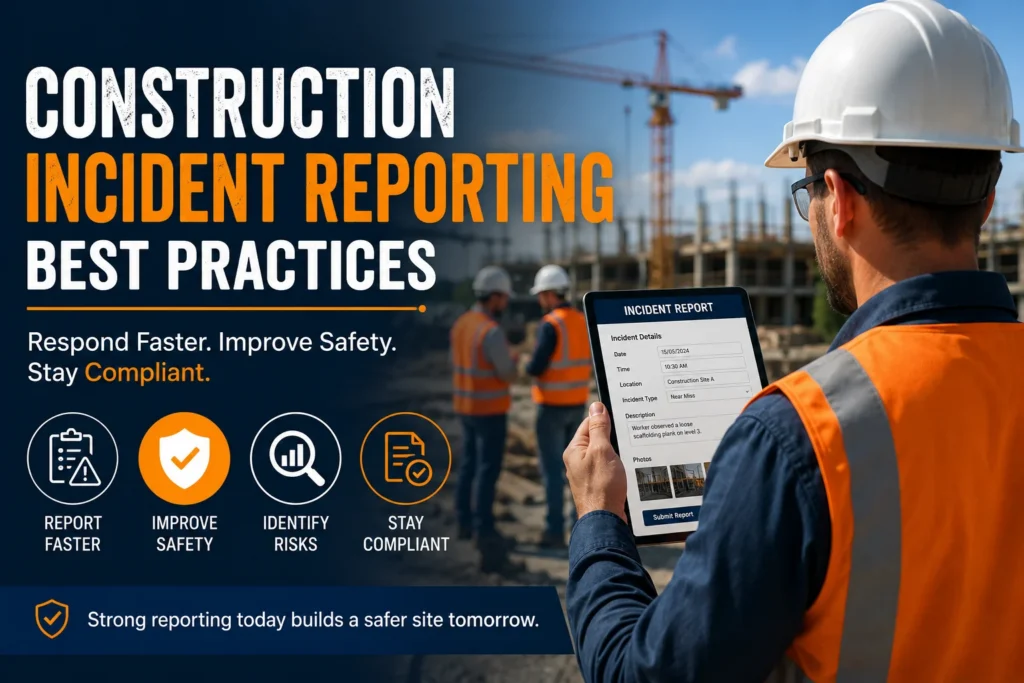
Construction sites are busy, high-risk environments where incidents can happen even when strong safety procedures are in place. A minor injury, equipment failure, near miss, property damage, or unsafe condition can quickly become a serious issue if it is not reported and addressed properly.
That is why incident reporting in construction is more than simply filling out a form. A good reporting process helps Australian construction companies respond faster, identify hazards, maintain accurate records, and support their WHS compliance obligations.
However, many construction businesses still rely on paper forms, spreadsheets, emails, and disconnected records. As a result, important information can be delayed, lost, or difficult to track.
What Is Incident Reporting in Construction?
Incident reporting is the process of recording, investigating, and managing workplace incidents, injuries, hazards, near misses, and other safety events.
On an Australian construction site, an effective incident report should capture important details such as:
- Date, time, and location of the incident
- People involved and witnesses
- Description of what happened
- Injury or property damage details
- Immediate actions taken
- Photos or supporting evidence
- Identified hazards and contributing factors
- Corrective and preventive actions
- Investigation findings
- Person responsible for follow-up
- Closure status and completion date
Most importantly, the information should be recorded while the details are still fresh.
Why Fast Incident Reporting Matters on Construction Sites
When an incident is reported quickly, site managers can take action before the same problem happens again.
For example, if a worker identifies a damaged electrical cable and reports it immediately, the hazard can be isolated and repaired before someone is injured.
Similarly, a near miss report can reveal weaknesses in site procedures even when nobody was hurt.
Fast reporting helps construction businesses:
- Respond to hazards sooner
- Improve workplace safety
- Identify recurring risks
- Create reliable safety records
- Support incident investigations
- Track corrective actions
- Demonstrate stronger WHS management
Therefore, incident reporting should be treated as part of everyday safety management rather than an administrative task completed after an event.
7 Incident Reporting Best Practices for Australian Construction
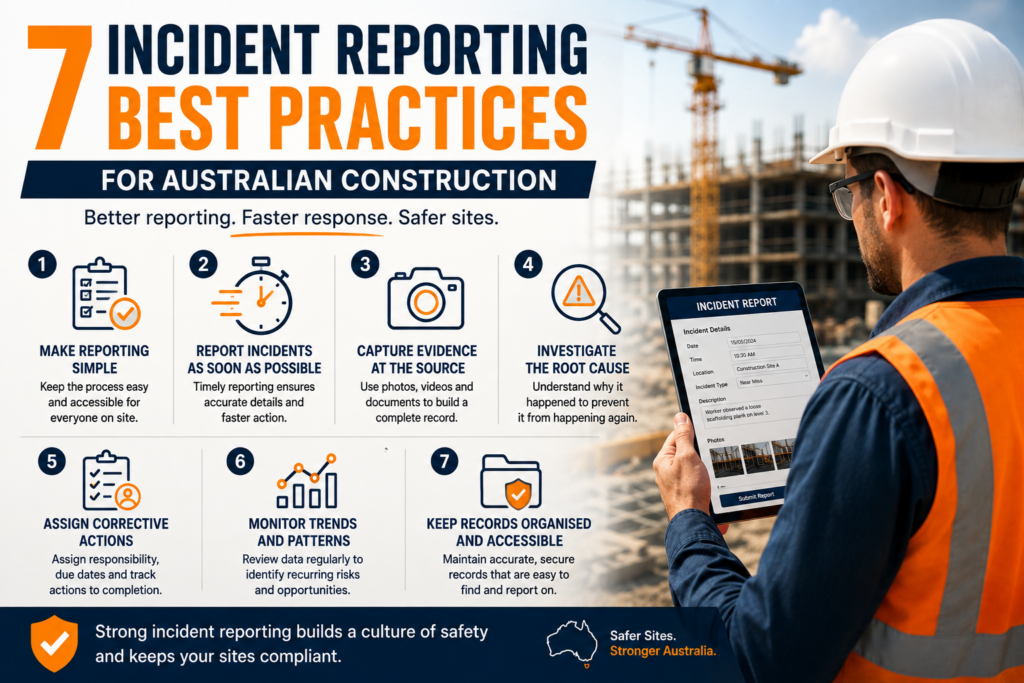
1. Make Reporting Simple for Workers
If reporting an incident requires several steps, workers may delay it or avoid reporting minor events altogether.
Instead, provide a straightforward process that can be accessed from the construction site.
Mobile-friendly digital reporting can allow workers and supervisors to submit information directly from their phones or tablets.
The easier the process is, the more likely people are to report hazards and near misses consistently.
2. Report Incidents as Soon as Possible
Timely reporting improves the accuracy of incident information.
Encourage workers to report:
- Injuries and illnesses
- Near misses
- Unsafe work practices
- Equipment or machinery failures
- Property damage
- Environmental incidents
- Hazardous conditions
- Security or site access issues
Furthermore, supervisors should have a clear escalation process for incidents that require immediate attention.
3. Capture Evidence at the Source
Written descriptions are useful, but photographs and supporting evidence can provide additional context.
For example, a digital incident reporting system can allow users to attach:
- Site photographs
- Videos
- Documents
- Inspection records
- Witness information
- Corrective action evidence
This creates a more complete incident record and makes later investigation easier.
4. Investigate the Root Cause
An incident report should not stop at “what happened?”
Construction companies should also ask:
Why did it happen?
For example:
| Incident | Immediate Cause | Possible Root Cause | Corrective Action |
|---|---|---|---|
| Worker slips | Wet surface | Poor housekeeping | Improve cleaning inspections |
| Equipment damage | Incorrect operation | Training gap | Additional operator training |
| Near miss with vehicle | Poor visibility | Traffic management issue | Review site traffic plan |
| Fall hazard identified | Missing guardrail | Inadequate inspection | Add pre-start verification |
This approach helps organisations address the underlying problem instead of simply fixing the immediate issue.
5. Assign Corrective Actions
Identifying a problem is only the first step.
Every significant incident should result in clearly defined actions where appropriate. Each action should have:
- A responsible person
- A due date
- A priority
- A status
- Supporting evidence
- Completion verification
Consequently, managers can see which safety issues remain open and which have been resolved.
6. Monitor Recurring Incidents and Trends
One incident may appear isolated. However, several similar incidents can reveal a larger safety problem.
Construction managers should regularly review incident data to identify patterns such as:
- Repeated equipment failures
- Frequent manual-handling injuries
- Recurring slips and trips
- Repeated subcontractor issues
- High-risk locations
- Common causes of near misses
- Departments or activities with increasing incidents
Over time, this information can help safety teams make better decisions about training, inspections, procedures, and risk controls.
7. Keep Records Organised and Accessible
Incident records are valuable only when they can be found and used.
Paper forms and scattered spreadsheets can make it difficult to answer basic questions such as:
- How many incidents occurred this month?
- Which sites have the most incidents?
- Are corrective actions overdue?
- What hazards are recurring?
- Which incidents remain open?
- Can supporting evidence be retrieved quickly?
A centralised digital system can make this information significantly easier to manage.
Incident Reporting and Australian WHS Compliance
Australian construction businesses need to manage workplace health and safety risks and maintain appropriate records and processes. However, WHS requirements can differ between Australian states and territories, so businesses should always confirm the requirements applicable to their location and type of work.
A strong incident management process should therefore support:
- Consistent incident documentation
- Hazard identification
- Risk management
- Corrective action tracking
- Investigation records
- Evidence management
- Safety trend analysis
- Secure record keeping
Importantly, software does not replace your WHS procedures or legal responsibilities. Instead, it can help your team manage the information and workflows required to support them.
How Digital Incident Reporting Improves Construction Safety
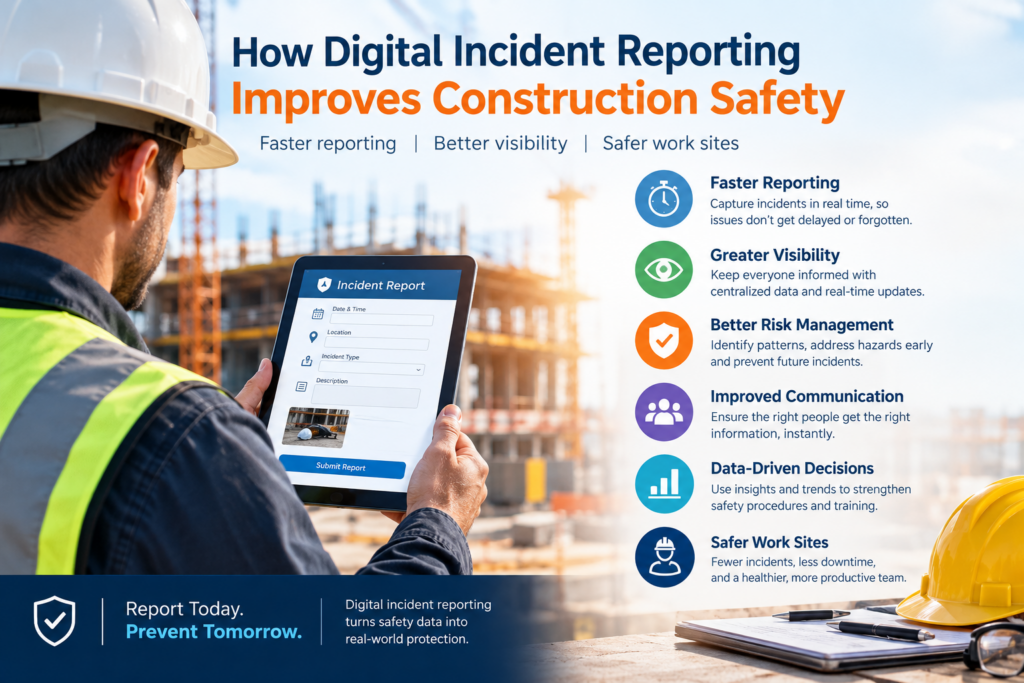
Modern construction companies are increasingly moving from paper-based safety processes to digital systems.
With digital incident reporting, teams can capture information from the field and make it available to managers without waiting for paperwork to move between offices and sites.
Paper-Based vs Digital Incident Reporting
| Area | Paper/Spreadsheet Process | Digital Process |
|---|---|---|
| Incident submission | Manual | Mobile/digital |
| Evidence | Often stored separately | Attached to record |
| Action tracking | Manual follow-up | Centralised tracking |
| Reporting | Time-consuming | Faster reporting |
| Record search | Difficult | Searchable |
| Trend analysis | Limited | Easier to analyse |
| Management visibility | Delayed | Near real-time |
As a result, digital reporting can help reduce administrative work while giving safety teams better visibility over what is happening across their projects.
Manage Incident Reporting with Sky Soft Compliance
Sky Soft Compliance helps construction businesses move important safety and compliance processes into a centralised digital environment.
Instead of managing incident information across paper forms, spreadsheets, emails, and separate folders, teams can use a structured platform to manage compliance-related activities and records.
Depending on your workflow, a digital compliance platform can help you:
- Record incidents and safety events
- Manage corrective actions
- Maintain supporting documentation
- Track outstanding tasks
- Standardise safety forms and checklists
- Improve visibility across projects
- Maintain organised compliance records
- Generate reports for management review
Most importantly, bringing safety information into one system makes it easier for managers to identify issues, follow up on actions, and maintain a more consistent compliance process.
Build a Stronger Incident Reporting Process
Effective construction incident reporting is not about creating more paperwork. It is about making sure the right information reaches the right people at the right time.
For Australian construction companies, the strongest approach combines:
Simple reporting + fast response + accurate evidence + root-cause investigation + corrective action + ongoing monitoring.
When these elements work together, incident reporting becomes more than a compliance exercise. It becomes a practical tool for improving site safety and preventing similar incidents from happening again.
With the right digital compliance software, construction teams can spend less time chasing records and more time managing the risks that matter.
Read more : Preparing for an ISO 9001 Audit? Follow This Construction Site Checklist
FAQ’s
Incident reporting is the process of documenting workplace injuries, hazards, near misses, property damage, and other safety events on a construction site.
Fast reporting allows construction teams to respond to hazards quickly, investigate incidents accurately, and reduce the risk of similar events happening again.
A report should include the incident details, people involved, location, photographs or evidence, immediate actions, investigation findings, and corrective actions.
Yes. Digital compliance software such as Sky Soft Compliance can help teams record incidents, track corrective actions, organise evidence, and maintain centralised safety records.