
A site risk assessment is one of the most important tools supervisors use to identify hazards, evaluate risks, and keep workers safe. However, a risk assessment is only useful when it reflects the actual conditions on site.
Work environments change constantly. Equipment moves, tasks change, contractors arrive, weather conditions shift, and new hazards can appear. Therefore, supervisors need a practical process for keeping site risk assessments accurate, current, and accessible.
This guide explains what a site risk assessment involves, how supervisors can manage it effectively, and how digital compliance software can make the process easier.
What Is a Site Risk Assessment?
A site risk assessment is a structured process for identifying workplace hazards, evaluating the likelihood and potential impact of those hazards, and deciding what controls are required to reduce the risk.
In simple terms, it answers three key questions:
- What could go wrong?
- How serious could the consequences be?
- What controls can prevent or reduce the risk?
A good risk assessment should reflect the specific worksite, activities, equipment, people, and environmental conditions involved.
Why Are Site Risk Assessments Important?
Risk assessments help supervisors move from simply reacting to incidents to actively preventing them.
They can help organizations:
- Identify hazards before work begins
- Evaluate health and safety risks
- Establish appropriate control measures
- Communicate risks to workers and contractors
- Demonstrate compliance
- Improve safety inspections
- Reduce workplace incidents
- Create a documented safety trail
However, completing a risk assessment once and leaving it unchanged is not enough. Risk assessment should be an ongoing process.
When Should a Site Risk Assessment Be Updated?
One of the most common mistakes is treating a risk assessment as a static document.
Instead, supervisors should review it whenever something changes that could affect workplace safety.
| Situation | Why Review Is Needed |
|---|---|
| New equipment introduced | New mechanical or operational hazards may exist |
| Work activity changes | Existing controls may no longer be suitable |
| New contractors arrive | Competency, responsibilities, and site risks may change |
| Weather conditions change | Environmental risks can increase |
| An incident or near miss occurs | Existing controls may need improvement |
| Regulations or procedures change | Assessment may need to reflect new requirements |
| Site layout changes | Access, movement, and emergency risks can change |
| Periodic review is due | Ensures controls remain effective |
Therefore, supervisors should not rely only on a calendar-based review. A change in working conditions should trigger a risk assessment review.
What Should a Site Risk Assessment Include?
While the exact format can vary depending on the industry and activity, an effective assessment generally includes several core elements.
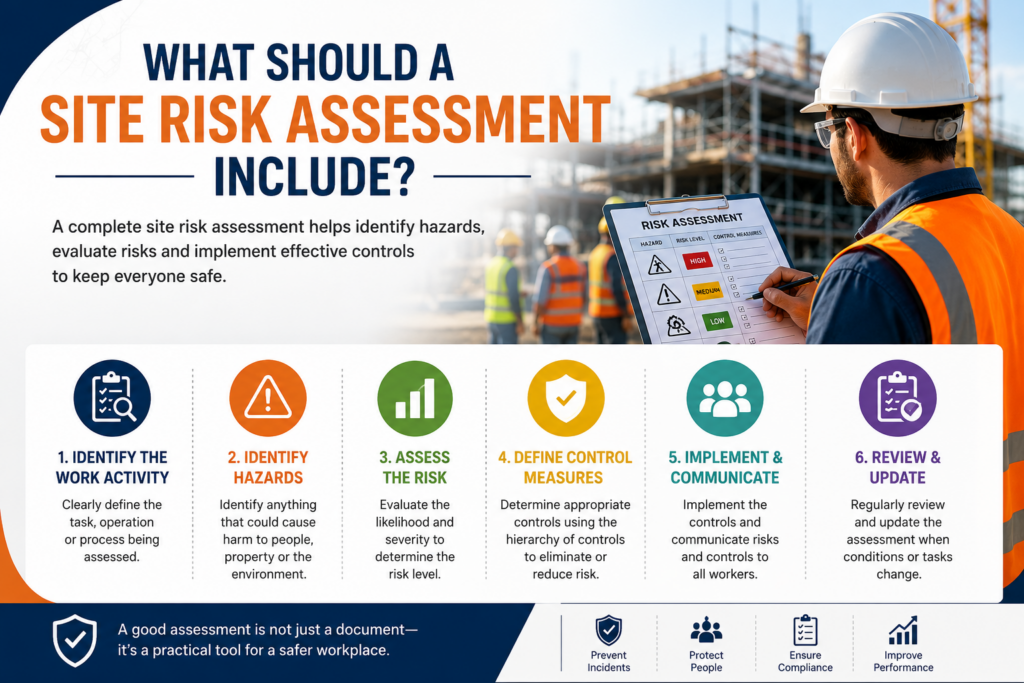
1. Identify the Work Activity
Start by clearly defining the task or operation being assessed.
For example:
- Working at height
- Lifting operations
- Hot work
- Confined space entry
- Electrical work
- Equipment maintenance
- Manual handling
- Vehicle movement
Being specific makes it easier to identify relevant hazards.
2. Identify Potential Hazards
Next, identify anything that could cause harm.
Depending on the site, hazards may include:
- Moving machinery
- Electricity
- Chemicals
- Noise
- Working at height
- Falling objects
- Slips and trips
- Fire
- Vehicle movements
- Poor housekeeping
- Environmental conditions
Supervisors should consider both routine and non-routine activities.
3. Assess the Risk
Risk is commonly evaluated by considering the likelihood of an event occurring and the potential severity of its consequences.
A simple risk matrix can help supervisors prioritize hazards.
For example:
Risk = Likelihood × Severity
The exact scoring system should follow the organization’s approved risk methodology.
4. Define Control Measures
Once risks have been identified, determine how they can be controlled.
Where appropriate, supervisors should consider the hierarchy of controls, moving from eliminating the hazard toward less effective controls such as personal protective equipment.
Controls may include:
- Eliminating the hazard
- Substituting a safer method
- Engineering controls
- Administrative controls
- Personal protective equipment (PPE)
The goal is not simply to document controls. The goal is to ensure they are implemented and effective in practice.
How Can Supervisors Keep Risk Assessments Accurate?
Creating a good assessment is only the first step. Keeping it accurate requires regular involvement from supervisors and workers.
Review Conditions Before Work Starts
Before starting a task, supervisors should compare the documented assessment with actual site conditions.
Ask:
- Has anything changed?
- Are the same people performing the task?
- Is the equipment still the same?
- Have environmental conditions changed?
- Are the required controls in place?
- Have new hazards appeared?
This quick check can identify gaps before work begins.
Involve the People Doing the Work
Workers often have practical knowledge that may not be obvious from a written assessment.
Therefore, supervisors should encourage workers to report:
- New hazards
- Unsafe conditions
- Changes in procedures
- Equipment problems
- Near misses
- Ineffective controls
This creates a more realistic and continuously improving risk assessment process.
Record Changes Immediately
If a significant change occurs, avoid relying on memory or informal conversations.
Instead, document:
- What changed
- What new hazard was identified
- The revised risk level
- Additional controls
- Who reviewed the assessment
- When it was updated
This creates accountability and improves traceability.
Common Site Risk Assessment Mistakes
Even organizations with established safety procedures can encounter problems.
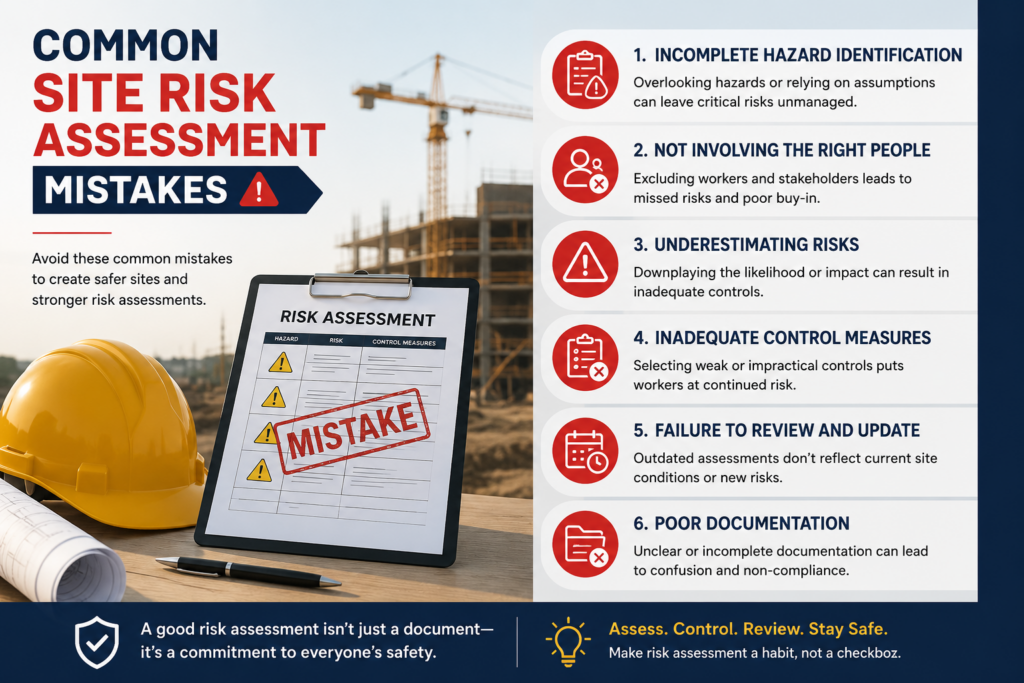
Outdated Assessments
An assessment may describe conditions that existed several months ago but no longer match the site.
Generic Templates
Templates save time, but copying the same assessment for every site or task can cause important hazards to be missed.
Poor Worker Communication
A risk assessment provides limited value if workers do not understand the hazards and controls relevant to their work.
Incomplete Follow-Up
Identifying a hazard is not enough. Supervisors must verify that corrective actions and controls have actually been implemented.
Paper-Based Record Keeping
Paper forms can become difficult to track, update, retrieve, and share—especially when multiple sites or teams are involved.
How Digital Compliance Software Can Help
Managing risk assessments digitally can make the process significantly more organized.
Sky Soft Compliance helps organizations manage compliance activities, documentation, inspections, and safety processes in a more structured digital environment.
Instead of depending entirely on spreadsheets and paper files, supervisors can use a centralized system to improve visibility and maintain more consistent records.
A digital compliance approach can help with:
- Centralized compliance records
- Digital forms and checklists
- Site inspection records
- Corrective action tracking
- Document management
- Audit preparation
- Compliance reporting
- User accountability
- Easier access to current information
Most importantly, digital records can make it easier for supervisors and management to understand what has been reviewed, what needs attention, and what actions remain open.
Site Risk Assessment: Paper vs. Digital
| Area | Paper-Based Process | Digital Process |
|---|---|---|
| Updating assessments | Manual | Easier to revise and manage |
| Record access | Physical files | Centralized access |
| Tracking actions | Manual follow-up | Structured tracking |
| Reporting | Time-consuming | Faster reporting |
| Audit preparation | File searching | Easier record retrieval |
| Version control | Can become difficult | More manageable |
| Multi-site management | Challenging | Better visibility |
Digitalization does not replace the supervisor’s judgment. Instead, it gives supervisors better tools to capture, manage, review, and act on safety information.
A Practical Risk Assessment Review Checklist
Before approving a site risk assessment, supervisors can ask:
- Does the assessment reflect current site conditions?
- Have all relevant work activities been considered?
- Are hazards clearly identified?
- Has the level of risk been evaluated?
- Are appropriate control measures documented?
- Are controls actually being implemented?
- Have workers been consulted?
- Have recent incidents or near misses been considered?
- Have changes to equipment, personnel, or procedures been reviewed?
- Is the latest version clearly identifiable?
- Are outstanding corrective actions being tracked?
This simple checklist can help prevent a risk assessment from becoming just another compliance document.
Read more : Digital Site Inspections: How They Reduce Incidents, Save Time and Keep Project Evidence Organised
Frequently Asked Questions
There is no universal interval that works for every workplace. A risk assessment should be reviewed periodically and whenever significant changes, incidents, new hazards, or changes in work activities occur.
Responsibility depends on the organization’s safety management system. Supervisors often play a key role because they are closest to day-to-day site conditions, while management remains responsible for ensuring appropriate processes and resources are in place.
An effective risk assessment is site-specific, current, practical, understood by workers, and connected to real control measures. It should lead to action rather than simply create paperwork.
Final Thoughts
A site risk assessment should never be treated as a document that is completed once and forgotten. It should evolve as the workplace changes.
Supervisors play a critical role in making that happen. By regularly reviewing site conditions, involving workers, documenting changes, and following up on control measures, they can keep risk information accurate and useful.
At the same time, digital compliance platforms such as Sky Soft Compliance can help organizations move away from fragmented paperwork and create a more structured approach to inspections, compliance records, corrective actions, and reporting.
Ultimately, the objective is simple: identify risks early, keep controls effective, and give teams the information they need to work safely.