Construction projects generate a huge amount of information every day. From site inspections and safety checklists to incident reports, risk assessments, equipment checks, and compliance records, teams need accurate information they can access when it matters.
For years, many construction companies relied on paper forms. However, as projects become more complex and compliance requirements increase, businesses are moving toward digital construction forms and inspection software.
The reason is simple: digital forms can make field data easier to capture, organize, review, and retrieve.
In this guide, we’ll compare digital vs. paper forms for construction, explain the key differences, and show how construction compliance software such as Sky Soft Compliance can help teams modernize their inspection and documentation workflows.
What Are Digital Construction Forms?
Digital construction forms are electronic versions of traditional paper documents used to collect and manage field information.
Instead of completing a printed checklist, a site supervisor or inspector can use a mobile phone, tablet, or computer to complete a digital form.
Common examples include:
- Construction site inspection forms
- Safety inspection checklists
- Risk assessment forms
- Incident reports
- Equipment inspection records
- Quality control checklists
- Site audit forms
- Daily site reports
- Permit and compliance forms
- Corrective action reports
Furthermore, digital forms can connect inspection data with a centralized system, making information easier for managers and compliance teams to review.
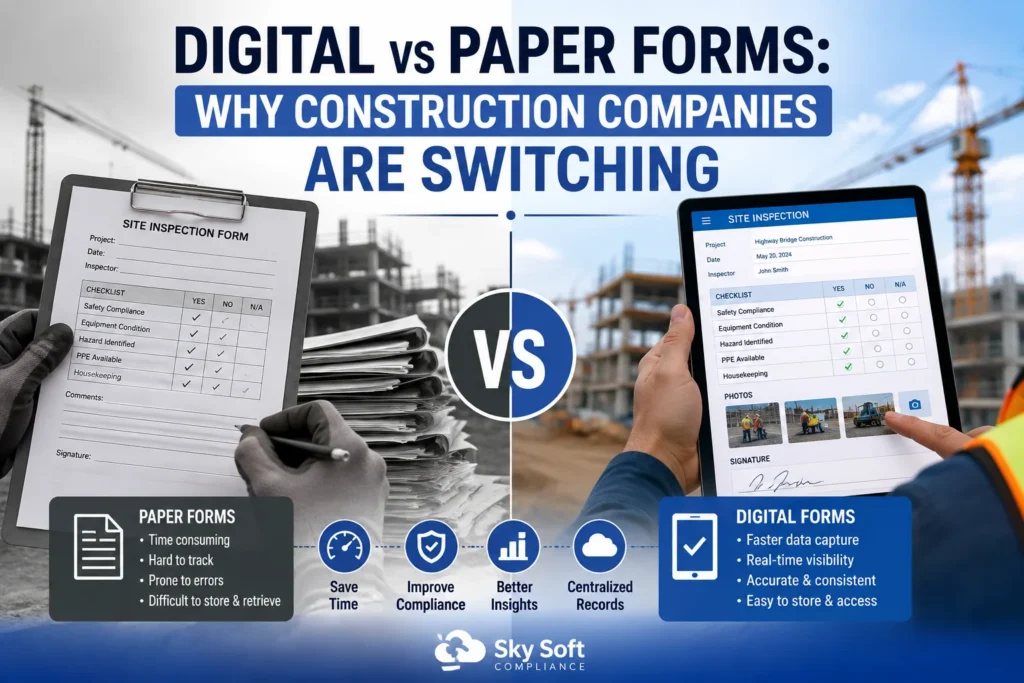
Digital vs. Paper Forms: Key Differences
| Factor | Paper Forms | Digital Forms |
|---|---|---|
| Data entry | Handwritten | Typed or selected digitally |
| Accessibility | Physical document required | Accessible through connected devices |
| Data storage | Filing cabinets and folders | Centralized digital storage |
| Search | Manual | Quick digital search |
| Errors | More handwriting and missing-field risks | Required fields and validation can reduce errors |
| Photos | Printed or attached separately | Can be attached directly |
| Reporting | Manual data entry | Automated or streamlined reporting |
| Collaboration | Physical sharing | Easier digital sharing |
| Audit preparation | Time-consuming | Records can be organized centrally |
| Field updates | Requires paper handling | Can be updated digitally |
The difference becomes particularly important when a construction company manages multiple projects, sites, subcontractors, inspectors, and compliance records.
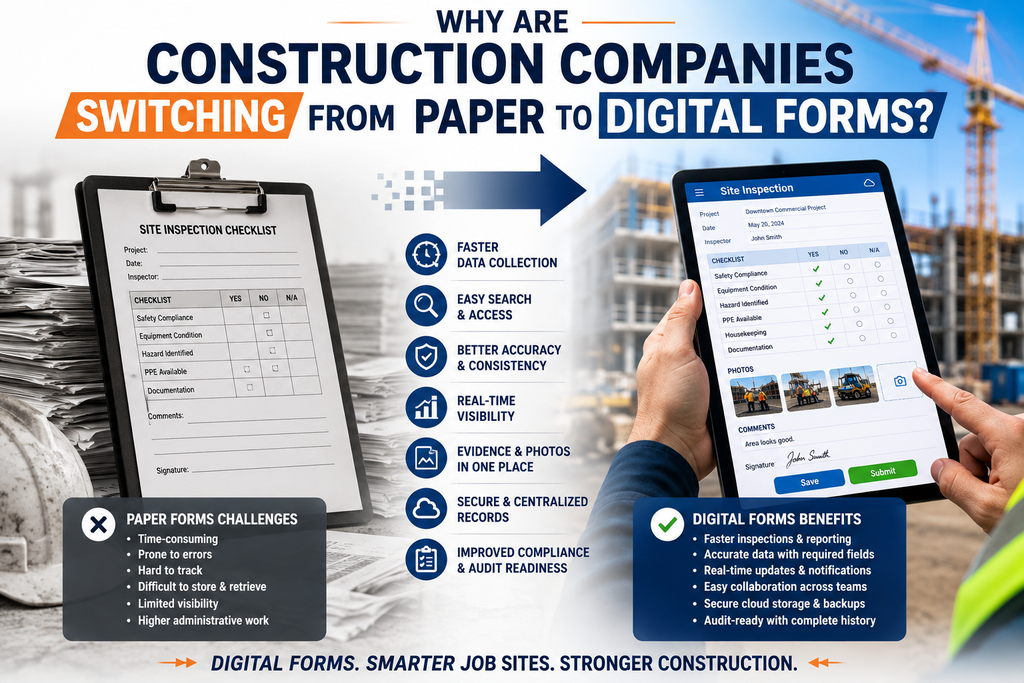
Why Are Construction Companies Switching From Paper to Digital Forms?
1. Faster Data Collection on Site
Paper forms require inspectors to write information manually and organize documents afterward.
With digital inspection forms, teams can enter information directly from the construction site. Drop-down menus, checkboxes, predefined responses, and required fields can also make the process more consistent.
As a result, inspectors can spend less time managing paperwork and more time focusing on the actual inspection.
2. Easier Access to Inspection Records
Finding an old paper inspection can take time, especially when records are stored across different project files.
Digital construction records, however, can be organized by:
- Project
- Site
- Inspection type
- Date
- Inspector
- Equipment
- Finding
- Corrective action
Therefore, managers can find the information they need without searching through physical folders.
3. Better Inspection Evidence Management
Construction inspections often require supporting evidence such as photos, documents, signatures, observations, and corrective actions.
Paper forms make this information harder to organize.
Digital forms can bring inspection information and supporting evidence together in one record. This creates a more complete inspection history and makes it easier to demonstrate what was inspected, what was found, and what action followed.
4. Fewer Manual Data-Entry Steps
One major problem with paper workflows is that information may need to be entered more than once.
For example:
Inspector → Paper Form → Office Staff → Spreadsheet → Report
This creates additional work and increases opportunities for transcription errors.
A digital workflow can reduce unnecessary re-entry:
Inspector → Digital Form → Centralized Record → Report
Consequently, teams can improve data consistency while reducing administrative work.
Digital Forms Improve Construction Compliance Management
Compliance is not simply about completing a checklist. Construction companies also need to demonstrate that inspections were performed properly and that issues were followed up.
A digital system can help organizations maintain a clearer record of:
- Inspection dates
- Findings and observations
- Responsible personnel
- Corrective actions
- Due dates
- Completion status
- Supporting photographs
- Approval records
- Audit history
This creates a more structured construction compliance management process.
For businesses preparing for internal audits, client reviews, or regulatory inspections, having organized digital records can also make document retrieval much easier.
1. Real-Time Visibility for Project Managers
Paper forms can create a delay between the time an inspection happens and the time management sees the results.
Digital construction inspection software can shorten this gap.
For example, if an inspector identifies a safety issue on site, the information can be recorded digitally and made available to the relevant team for review and follow-up.
Therefore, managers can gain better visibility into:
- Open inspection findings
- Outstanding corrective actions
- Recurring issues
- Project compliance activity
- Inspection completion
- High-priority risks
Instead of waiting for paperwork to reach the office, teams can work with more current information.
2. Easier Reporting and Audit Preparation
Creating reports manually from paper documents can consume significant administrative time.
Digital systems can organize inspection information into structured records that can support construction compliance reports, inspection summaries, and audit documentation.
For example, a company may want to answer:
Which inspections were completed on this project last month?
Or:
Which corrective actions are still outstanding?
With paper records, answering these questions may require manual searching. With structured digital records, the same information can be much easier to retrieve.
How Sky Soft Compliance Helps Construction Companies Go Digital
Sky Soft Compliance is designed to help construction businesses manage inspections, compliance activities, documentation, and field information digitally.
Instead of relying entirely on disconnected paper forms and spreadsheets, teams can move toward a centralized compliance workflow.
Depending on the organization’s requirements, digital compliance workflows can help with:
- Site inspections
- Safety checklists
- Risk assessments
- Compliance documentation
- Corrective actions
- Inspection records
- Evidence and attachments
- Audit preparation
- Project-level visibility
- Centralized document management
This can be especially useful for companies managing multiple construction sites where maintaining consistent inspection processes becomes increasingly difficult.
When Should a Construction Company Switch to Digital Forms?
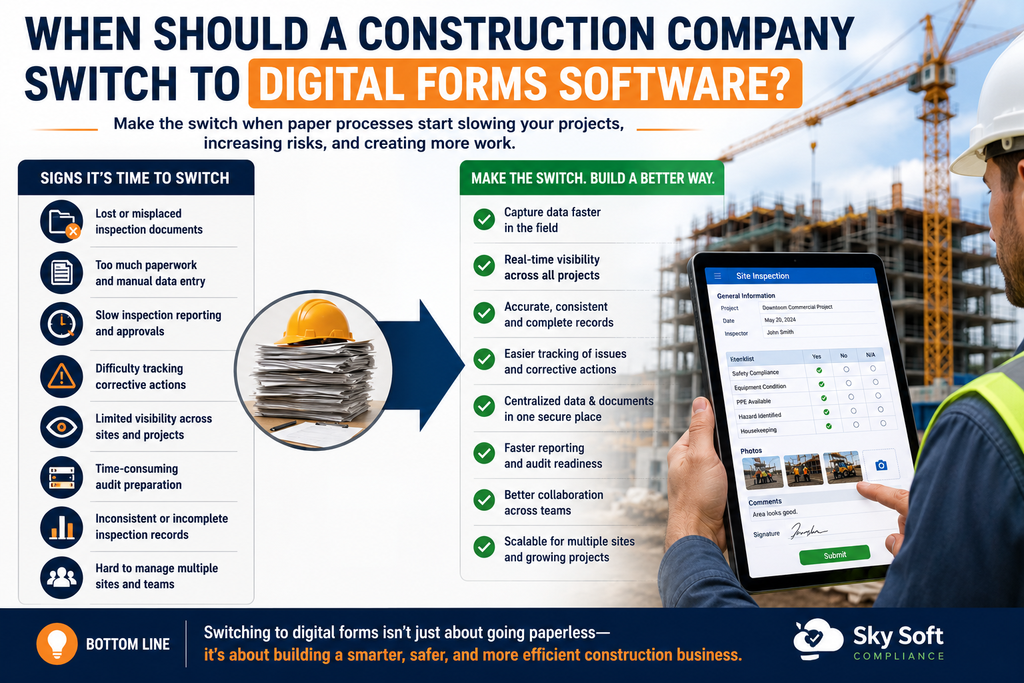
A company may benefit from moving away from paper when it starts experiencing problems such as:
- Lost or misplaced inspection documents
- Repeated manual data entry
- Slow inspection reporting
- Difficulty tracking corrective actions
- Large volumes of paperwork
- Limited visibility across projects
- Time-consuming audit preparation
- Difficulty retrieving historical records
- Inconsistent inspection documentation
However, switching does not necessarily mean digitizing every document immediately.
A practical approach is to start with high-volume, high-risk, or frequently repeated forms, then gradually expand the digital workflow.
Digital vs. Paper Forms: The Bigger Picture
The move from paper to digital forms is not simply about replacing a clipboard with a tablet.
It is about creating a more connected construction inspection and compliance workflow.
Digital forms can help companies move from:
Paper → Manual Entry → Filing → Searching → Reporting
to:
Digital Capture → Centralized Records → Tracking → Reporting → Better Visibility
As construction projects become more data-driven, having reliable digital records can support better communication, accountability, and compliance management.
Read more : Inspection and Test Plans (ITPs): How They Improve Construction Quality
Frequently Asked Questions
Digital forms can make construction inspections and compliance documentation easier to capture, organize, search, and report. They can also reduce repetitive administrative work.
Companies can digitize site inspection forms, safety checklists, risk assessments, incident reports, equipment inspections, quality checklists, audit forms, and corrective action records.
Yes. Modern construction compliance platforms can provide mobile-friendly workflows so field teams can complete forms and record information directly from the job site.
Digital records can centralize inspection information, evidence, corrective actions, and historical records, making relevant documentation easier to retrieve during an audit.
Yes. A centralized platform can help organizations manage inspection and compliance information across multiple projects while maintaining more consistent processes.
Final Thoughts
The shift from paper forms to digital construction forms reflects a broader change in how construction companies manage field data and compliance.
Paper may still work for simple workflows. However, as projects grow, managing inspections, evidence, corrective actions, and historical records manually can become increasingly difficult.
With a construction compliance platform such as Sky Soft Compliance, businesses can move toward a more organized digital approach that connects field inspections with centralized compliance management.
Ready to reduce paperwork and modernize your construction compliance workflow? Explore Sky Soft Compliance and see how digital inspection management can fit your business.