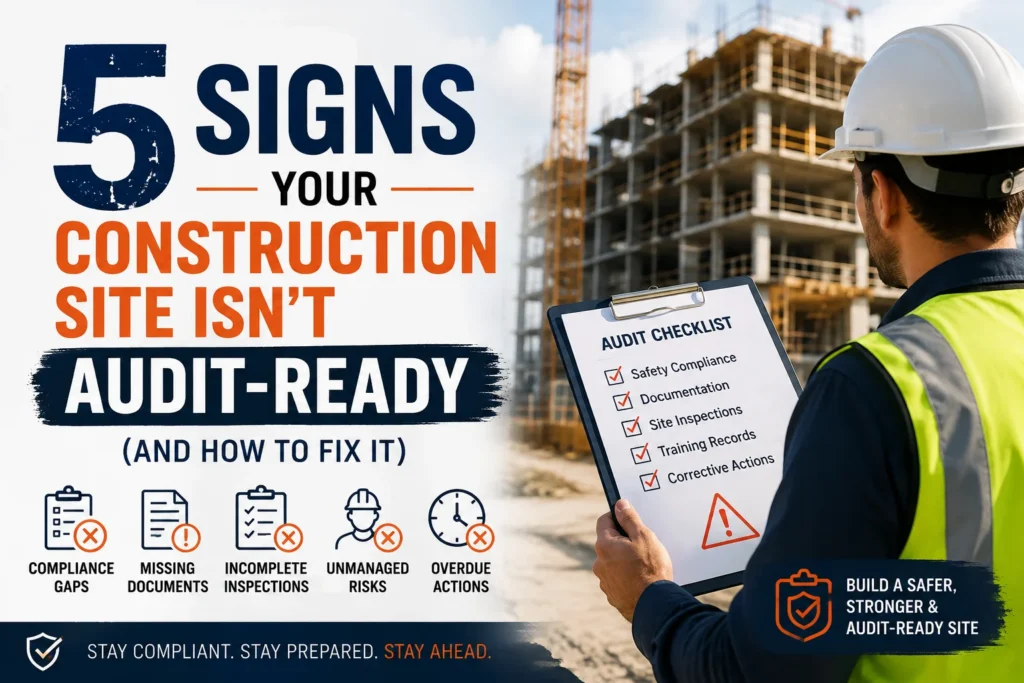
Construction sites rarely become non-compliant overnight. Instead, small gaps build up over time. A missed inspection, an outdated SWMS, an expired contractor document or an unresolved corrective action might not seem serious on its own. However, when an auditor asks for evidence, these gaps can quickly become a much bigger problem.
For Australian construction businesses, being audit-ready means more than keeping a folder full of policies. Your business needs to demonstrate that procedures are current, risks are controlled, workers are competent, and site activities are supported by reliable evidence. Auditors may look at documents as well as whether those processes are actually being followed.
The good news is that most audit-readiness problems can be fixed with a structured approach.
In this guide, we cover five common signs your construction site isn’t audit-ready and, more importantly, what you can do to fix each one.
What Does It Mean to Be Audit-Ready in Construction?
An audit-ready construction site is one where compliance information, safety records and supporting evidence can be accessed quickly and confidently.
Instead of scrambling when an auditor, client or principal contractor requests documentation, your team should be able to answer questions such as:
- Are the required WHS documents current?
- Are workers properly inducted and trained?
- Are SWMS relevant to the work being performed?
- Are inspections being completed and recorded?
- Are incidents and hazards being managed?
- Are corrective actions assigned and closed?
- Can you prove that contractors meet your requirements?
- Can you quickly produce reliable evidence?
Therefore, audit readiness is not simply a document-management exercise. It connects people, processes, site activities and evidence.
5 Signs Your Construction Site Isn’t Audit-Ready
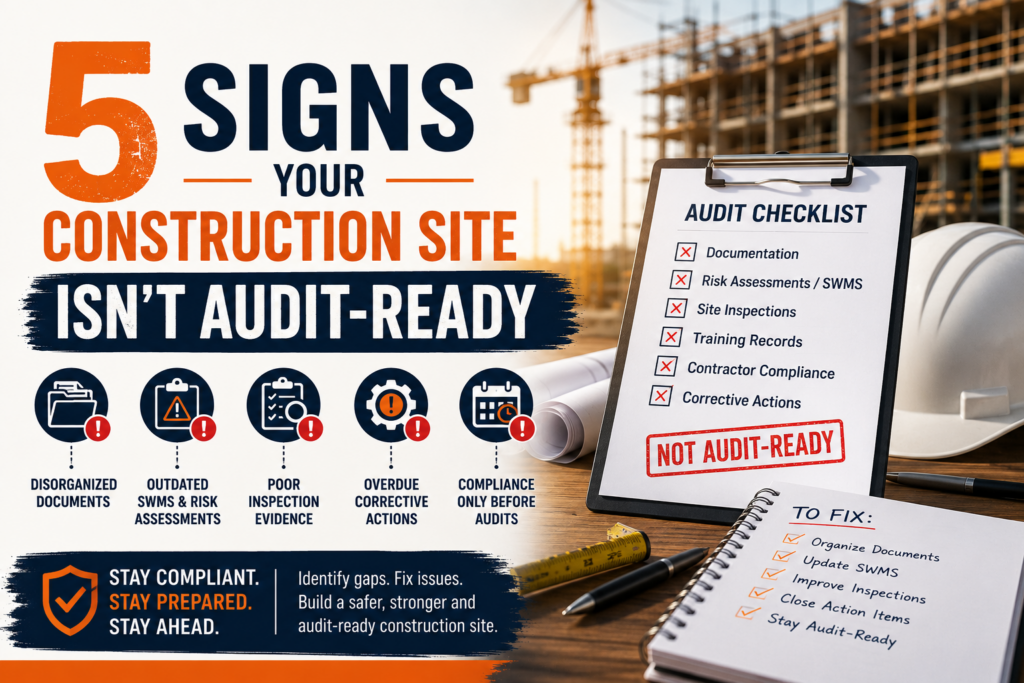
1. Your Compliance Documents Are Scattered Across Different Systems
One of the clearest warning signs is when your compliance information lives everywhere.
You might have:
- WHS documents in Google Drive
- SWMS in email attachments
- Inspection forms on paper
- Training records in spreadsheets
- Contractor documents in individual folders
- Incident reports stored separately
- Photos on workers’ phones
- Corrective actions tracked through email
At first, this system may appear manageable. However, as your number of projects, workers and subcontractors increases, finding the right evidence becomes increasingly difficult.
During an audit, the problem becomes even more obvious. You may technically have the required records, but if nobody can locate them quickly, your compliance process becomes difficult to demonstrate.
How to Fix It
Create a centralised construction compliance management system.
Your team should have one reliable place for:
| Compliance Area | Evidence to Manage |
|---|---|
| WHS | Policies, procedures and risk documentation |
| SWMS | Current SWMS and worker acknowledgement |
| Inspections | Site inspections, photos and observations |
| Incidents | Incident reports and investigations |
| Contractors | Qualifications, insurance and onboarding |
| Training | Inductions, licences and competency records |
| Corrective Actions | Open, assigned and closed actions |
| Quality | ITPs, defects and non-conformances |
| Environment | Environmental inspections and records |
A centralised system reduces document hunting. More importantly, it creates a clearer evidence trail for audits.
2. Your SWMS and Risk Assessments Don’t Match What Is Happening on Site
Having a SWMS does not automatically mean your site is audit-ready.
One common compliance gap occurs when the documentation says one thing while the site operates differently.
For example, a SWMS might describe a particular work method, but the team has changed the sequence of work because of site conditions. If the document has not been reviewed, there is now a gap between planned controls and actual work practices.
Likewise, risk assessments can become outdated when site conditions, equipment, personnel or work activities change.
Signs Your Risk Documentation Needs Attention
Watch for:
- Generic SWMS that are not site-specific
- Risk assessments that have not been reviewed
- Controls that workers do not understand
- Procedures that are difficult to access
- Changes on site that are not reflected in documentation
- Missing worker acknowledgement
- Different versions of documents being used
Australian construction compliance guidance commonly emphasises that risk assessments and SWMS should reflect actual work activities and that controls should be reviewed when circumstances change.
How to Fix It
Make risk management an ongoing process rather than a one-time activity.
Your workflow should look like this:
Identify → Assess → Control → Communicate → Inspect → Review → Update
For example, if the work method changes, the responsible supervisor should be able to review the relevant risk assessment or SWMS, update the controls and communicate the change to affected workers.
Digital forms can make this process considerably easier because updates, acknowledgements, photos and supporting evidence can remain connected to the relevant activity.
3. Your Site Inspections Are Happening, But the Evidence Is Weak
Another major warning sign is relying on statements such as:
“We inspect the site every day.”
An auditor will usually want more than a verbal confirmation.
They may want to see evidence that inspections occurred, what was identified, what action was taken and whether the issue was closed.
A useful site inspection record should provide context, including the site, date, inspector, observations, photos where appropriate and actions resulting from the inspection.
Daily and regular worksite inspections are an important part of maintaining construction safety and documenting site conditions.
Weak Inspection Evidence Often Looks Like:
- Undated paper checklists
- Missing signatures
- No photographs
- No responsible person assigned to findings
- Repeated issues with no follow-up
- Inspection records stored in different locations
- No clear record showing when actions were closed
How to Fix It
Move from inspection completion to inspection management.
A stronger process is:
- Complete the inspection.
- Record observations.
- Capture supporting photos.
- Identify non-conformances or hazards.
- Assign corrective actions.
- Set a due date.
- Track progress.
- Verify completion.
- Maintain the audit trail.
This approach creates a much stronger connection between finding a problem and proving that it was addressed.
4. Corrective Actions Keep Getting Carried Forward
Finding an issue is only the first step.
If your inspection identifies a hazard or non-conformance but the corrective action remains open for weeks, your compliance system has a weakness.
In fact, a large number of overdue corrective actions can indicate that your organisation identifies problems but does not consistently close them.
Ask Yourself:
- Who owns each corrective action?
- Is there a deadline?
- Can managers see overdue actions?
- Is evidence of completion attached?
- Who verifies that the action was actually effective?
- Can you see recurring issues across multiple sites?
If the answer to several of these questions is “no”, your corrective action process needs improvement.
How to Fix It
Every corrective action should have:
Issue → Owner → Priority → Due Date → Evidence → Verification → Closure
For example:
| Finding | Owner | Due Date | Evidence | Status |
|---|---|---|---|---|
| Damaged guardrail identified | Site Supervisor | 18 Aug | Repair photo | Closed |
| Missing signage | Project Manager | 19 Aug | Installation photo | In Progress |
| Equipment inspection overdue | Plant Manager | 20 Aug | Inspection certificate | Open |
This makes accountability much clearer.
More importantly, it allows management to identify recurring problems instead of simply closing individual actions.
5. You Only Think About Compliance When an Audit Is Coming
This is perhaps the biggest sign of all.
If your team starts searching for documents, updating registers and chasing subcontractors only after receiving an audit notice, your compliance process is reactive.
Audit readiness should be continuous.
A strong compliance management system should make audit preparation the result of everyday work rather than a separate project.
Reactive vs Proactive Compliance
| Reactive Approach | Proactive Approach |
|---|---|
| Prepare before an audit | Stay ready all year |
| Search for missing records | Maintain centralised records |
| Chase subcontractors manually | Track contractor compliance continuously |
| Review overdue actions late | Monitor actions throughout the project |
| Recreate evidence | Capture evidence when work happens |
| Depend on spreadsheets | Use connected digital workflows |
| Find problems during audits | Identify problems through regular inspections |
The difference is significant.
When compliance activities happen continuously, an audit becomes a review of your normal operations instead of a stressful document-recovery exercise.
How Digital Construction Compliance Software Improves Audit Readiness
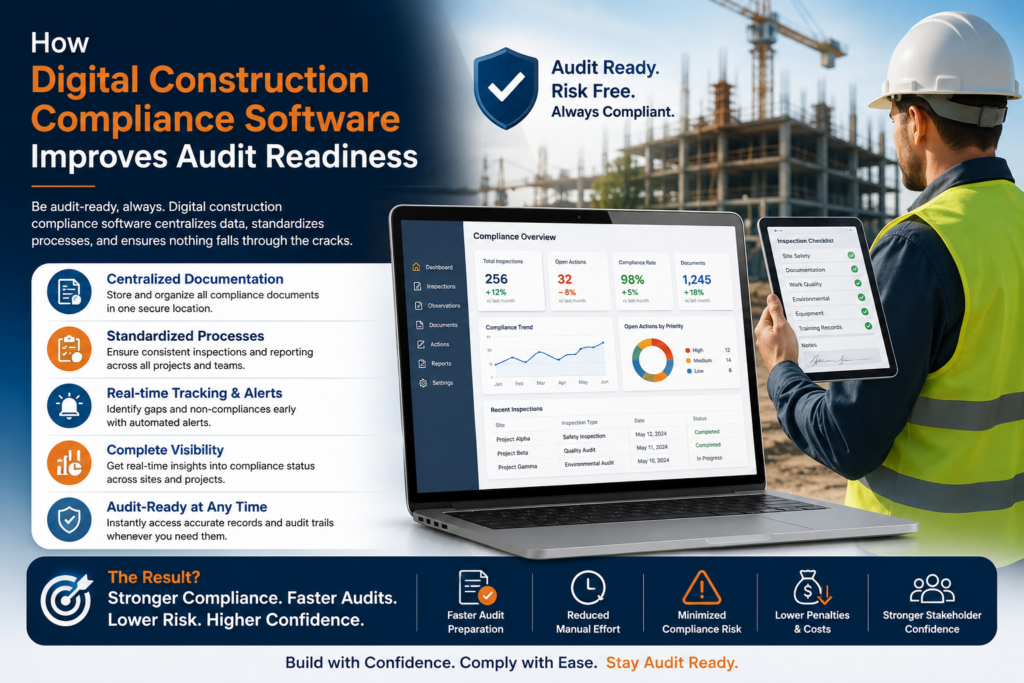
Traditional paper forms and disconnected spreadsheets can work for small projects. However, they become harder to manage as construction operations grow.
A construction compliance software platform can connect inspections, risk assessments, SWMS, incidents, contractors, corrective actions and reports within a single workflow.
That is where SkySoft Compliance can help.
SkySoft Compliance is designed specifically around construction QSE processes, helping teams digitise safety, quality and environmental activities across projects and sites. The platform supports areas including site inspections, risk assessments, SWMS management, incident reporting, toolbox talks, contractor management, corrective actions, ITPs and daily site reports.
What Can Sky Soft Compliance Help You Manage?
Site Inspections
Create and customise digital inspection forms, capture information on site and attach photographs to inspection records.
Risk Assessments and SWMS
Keep risk assessments and SWMS processes connected to your construction workflows, helping teams manage documentation more consistently.
Contractor Management
Manage subcontractor onboarding, pre-qualification, communication and ongoing compliance requirements from one system. Contractor compliance is particularly important because principal contractors may need evidence of licences, insurance, inductions and other requirements.
Corrective Actions
Assign actions, communicate with responsible people, monitor progress and track closure with an audit trail.
Digital Evidence Collection
Capture photos, signatures and other evidence as part of the relevant form or workflow instead of relying on separate files.
Multi-Site Visibility
Manage multiple projects and sites while maintaining consistent processes and visibility across your construction portfolio.
Audit-Ready Reporting
SkySoft Compliance provides branded reporting and is designed to help construction teams maintain audit-ready records throughout their projects rather than preparing everything at the last minute.
Construction Site Audit Readiness Checklist
Before your next internal, client or principal contractor audit, review these areas:
- WHS policies and procedures are current
- Relevant risk assessments are up to date
- SWMS reflect current work activities
- Workers have completed required inductions
- Training and competency records are current
- Contractor documentation has been verified
- Site inspections are completed and recorded
- Inspection findings have assigned corrective actions
- Corrective actions are tracked through to closure
- Incident and near-miss records are maintained
- Toolbox talks are documented
- Plant and equipment inspections are recorded
- Emergency procedures and relevant records are accessible
- Quality inspections and ITP records are organised
- Environmental compliance records are available
- Evidence can be retrieved quickly when requested
Why Construction Companies Should Aim for Continuous Audit Readiness
Audit readiness is not simply about avoiding a failed audit.
A well-managed compliance system can also help construction businesses improve day-to-day operations.
When teams can identify hazards earlier, track corrective actions faster and access reliable records, they can reduce administrative friction and make better operational decisions.
Furthermore, a connected system can help management identify patterns across projects.
For example, if the same inspection issue appears repeatedly across several sites, the business can investigate the underlying cause instead of treating every occurrence as an isolated event.
This shifts compliance from paperwork and administration to continuous improvement.
Read more : The True ROI of Safety Compliance for Construction Companies
Frequently Asked Questions About Construction Site Audit Readiness
An audit-ready construction site has current compliance documentation, appropriate controls, trained workers, completed inspections and reliable evidence showing that required processes are being followed.
The exact requirements vary by project, contract and jurisdiction. However, construction audits commonly review WHS policies, risk assessments, SWMS, training records, inspections, incident reports, contractor documentation, corrective actions and other project-specific records.
Start by reviewing your compliance documentation, site inspections, SWMS, training records, contractor records and corrective actions. Then check whether the evidence is current, accessible and consistent with what is happening on site.
The appropriate frequency depends on your organisation, projects, risks, contractual requirements and applicable legislation. However, compliance should be monitored continuously rather than only immediately before an external audit.
Yes. Digital compliance software can help centralise records, standardise inspections, capture evidence, manage corrective actions and make compliance information easier to retrieve. However, software does not replace good safety practices, competent people or appropriate compliance processes.
Final Thoughts
A construction site does not become audit-ready by updating a few documents the night before an audit.
Instead, audit readiness comes from building reliable processes into everyday site operations.
If your documents are scattered, your SWMS are outdated, inspections lack evidence, corrective actions remain open or your team only focuses on compliance before an audit, it is time to change the approach.
By centralising compliance activities, capturing evidence as work happens and continuously tracking actions, construction businesses can create a stronger and more transparent compliance environment.
SkySoft Compliance helps construction teams move away from disconnected paperwork and towards a digital QSE workflow built around real site activities. From inspections and SWMS to contractor management, corrective actions and reporting, the goal is simple: stay organised, stay compliant and stay audit-ready.