

Preparing for an ISO 9001 audit can be challenging for construction companies, especially when site records are spread across paper forms, spreadsheets, emails, photos, and different project folders.
However, an audit does not have to become a last-minute scramble.
With the right ISO 9001 audit checklist for construction, your team can organise records, identify missing evidence, and demonstrate that quality processes are being followed consistently.
This guide explains how to get your construction site records audit-ready and what documents auditors are likely to review.
What Is an ISO 9001 Audit?
An ISO 9001 audit evaluates whether an organisation’s Quality Management System (QMS) meets the requirements of ISO 9001 and is being effectively implemented.
For construction companies, this means auditors may look beyond your quality manual. They can also examine evidence from actual projects and site activities.
For example, auditors may review:
- Inspection and test records
- Site quality inspections
- Non-conformance reports (NCRs)
- Corrective action records
- Risk assessments
- Method statements
- Equipment inspection records
- Material approvals
- Subcontractor records
- Training and competency records
- Quality-related photographs
- Document revisions and approvals
Therefore, having a documented process is not enough. You need evidence that your team actually follows it.
Why Construction Site Records Matter During an ISO 9001 Audit
Construction projects generate large amounts of quality information every day.
Unfortunately, important records can easily become difficult to locate.
A site manager might have inspection photos on a phone, an NCR in an email, a checklist in a spreadsheet, and supporting documentation in a project folder.
As a result, an auditor may struggle to see a complete and traceable record.
Auditors Typically Look for Three Things
| Audit Area | What the Auditor Wants to See |
|---|---|
| Compliance | Required procedures and controls are being followed |
| Evidence | Activities are supported by accurate records |
| Traceability | Records can be linked to the project, activity, date and responsible person |
So, your goal should not simply be to collect more documents. Instead, focus on creating complete, accurate and traceable quality records.
ISO 9001 Audit Checklist for Construction Site Records
Use the following checklist before your next audit.
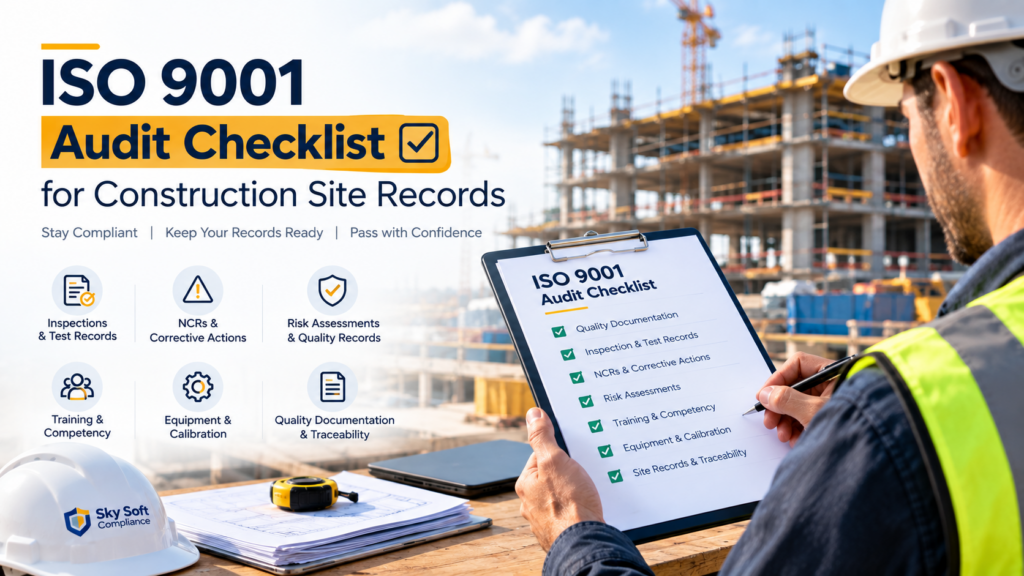
1. Review Your Quality Documentation
First, make sure your core QMS documentation is current.
Check that you have:
- Quality policies and objectives
- Quality procedures
- Inspection and testing procedures
- Project quality plans
- Document control procedures
- Corrective action procedures
- Non-conformance procedures
- Risk and opportunity processes
Also, verify that employees are using the latest approved versions of documents.
2. Check Inspection and Test Records
Inspection records are among the most important forms of evidence on a construction project.
Make sure inspection records clearly show:
- Project and site identification
- Inspection date
- Inspection type
- Relevant location or activity
- Inspection findings
- Pass/fail status
- Inspector’s name
- Corrective actions where required
- Supporting photographs
- Approval or sign-off
Most importantly, confirm that completed inspections can be quickly retrieved.
3. Audit Your Non-Conformance Records
An ISO 9001 audit may examine how your organisation responds when something goes wrong.
Review your non-conformance reports (NCRs) and check whether they contain:
- Description of the problem
- Date and location
- Immediate action
- Root cause, where required
- Corrective action
- Responsible person
- Completion date
- Verification of effectiveness
Furthermore, make sure closed NCRs have supporting evidence rather than simply being marked “complete.”
4. Verify Corrective Action Records
Corrective action demonstrates that your organisation does more than identify problems.
It shows that you learn from them.
Therefore, review whether corrective actions are:
- Assigned to specific people
- Given realistic deadlines
- Properly documented
- Supported by evidence
- Verified after completion
- Closed only when the required action has been completed
5. Check Risk and Quality Records
Construction quality can be affected by changing site conditions, subcontractors, materials, equipment and work methods.
Before an audit, review your relevant construction quality risk assessments and confirm that identified risks are being controlled.
Check for evidence relating to:
- Quality risks
- Project-specific risks
- Changes in work conditions
- Subcontractor risks
- Material or supplier risks
- Inspection requirements
- Preventive controls
Pro Tip: Connect Risks to Actual Site Activities
A risk assessment should not exist only as a document in a project folder.
Where possible, connect identified risks with inspections, corrective actions and site evidence. This creates a stronger audit trail.
6. Review Training and Competency Records
ISO 9001 also focuses on competency.
Make sure your records demonstrate that employees and relevant subcontractors have the required skills and training for their responsibilities.
Review:
- Training certificates
- Competency assessments
- Induction records
- Toolbox talks
- Role-specific training
- Refresher training
- Training expiry dates
Also, identify certificates or qualifications that are close to expiry.
7. Verify Equipment and Inspection Records
Construction projects often rely on tools, equipment and measuring devices.
Therefore, check whether inspection, testing and calibration records are current.
Look for:
- Equipment identification
- Inspection dates
- Calibration certificates
- Next due dates
- Inspection results
- Defects or failures
- Corrective actions
If equipment is overdue for inspection or calibration, resolve the issue before the audit wherever possible.
Construction ISO 9001 Audit Readiness: Common Problems to Fix
Before the auditor arrives, look for these common weaknesses:
| Common Problem | Why It Creates Risk |
|---|---|
| Missing inspection records | No evidence that required checks occurred |
| Incomplete signatures | Weak accountability and traceability |
| Old document versions | Staff may follow outdated requirements |
| Unclosed NCRs | Indicates ineffective corrective action |
| Missing photos | Supporting evidence may be incomplete |
| Scattered records | Makes retrieval difficult |
| Expired training | Competency evidence may be insufficient |
| Overdue equipment checks | Creates compliance and quality concerns |
| Poor document naming | Records become difficult to retrieve |
Consequently, a pre-audit review should focus on both record completeness and record accessibility.
How Digital Construction Compliance Software Helps

Managing ISO 9001 records manually becomes increasingly difficult as construction projects grow.
That is where digital construction compliance software can make a significant difference.
Instead of keeping quality records across disconnected spreadsheets, folders and emails, a central platform can help teams manage inspections, records, corrective actions and supporting evidence in a more structured way.
Using Sky Soft Compliance Software for Audit Readiness
Sky Soft Compliance Software helps construction teams move away from fragmented compliance processes and manage important site information digitally.
With a centralised compliance workflow, teams can improve how they capture and organise:
- Site inspections
- Compliance records
- Corrective actions
- Non-conformances
- Supporting evidence
- Photos and attachments
- Project documentation
- Action tracking
More importantly, digital records can make it easier for teams to demonstrate what was checked, when it was checked, who completed it, and what happened afterward.
That traceability can be especially valuable when preparing for an ISO 9001 audit.
From Last-Minute Preparation to Continuous Audit Readiness
The best approach is not to prepare your records only a few days before an audit.
Instead, make audit readiness part of your everyday construction quality process.
For example:
Site Activity → Inspection → Finding → Corrective Action → Evidence → Verification → Closure
When this information is captured consistently, your organisation can build an audit trail throughout the project rather than reconstructing it later.
Final ISO 9001 Construction Audit Checklist
Before your ISO 9001 audit, ask:
- Are current QMS documents available?
- Are site inspection records complete?
- Can records be traced to specific projects and activities?
- Are NCRs properly documented and closed?
- Are corrective actions verified?
- Are risk assessments current?
- Are training and competency records up to date?
- Are equipment inspections and calibrations current?
- Are supporting photographs and evidence attached?
- Can your team quickly retrieve requested records?
- Are outdated or duplicate documents controlled?
- Can you demonstrate an end-to-end audit trail?
If you can confidently answer yes to these questions, your construction site records are much more likely to be audit-ready.
Read more : Incident Reporting Best Practices for Australian Construction Sites
Frequently Asked Questions
Key records include site inspections, NCRs, corrective actions, risk assessments, training records, equipment checks, and quality documentation.
Review records for completeness, update outdated documents, close outstanding actions, and ensure all evidence is easy to trace and retrieve.
Yes. Digital compliance software can centralise inspections, records, actions, photos, and evidence, making audit preparation faster and more organised.