
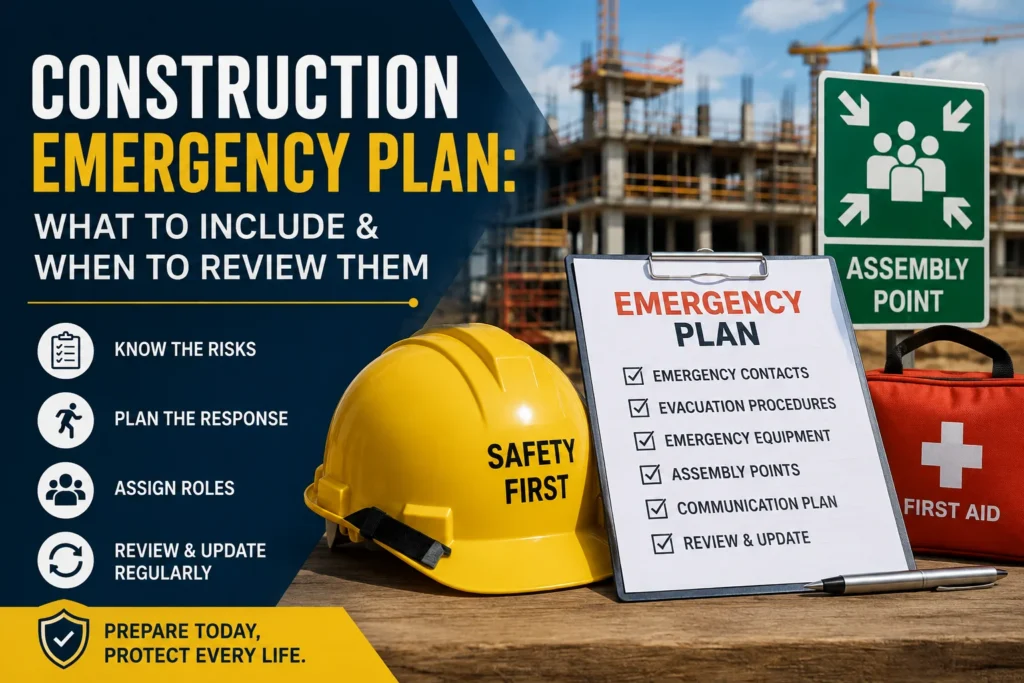
A construction emergency can happen without warning. A fire, serious injury, structural incident, hazardous material spill, extreme weather event, or equipment failure can quickly turn a normal workday into a critical situation.
That is why every construction project needs a clear and practical construction emergency plan.
An emergency plan is more than a document stored in a project folder. It should tell workers, supervisors, contractors, and emergency responders what to do, who is responsible, where to go, and how to communicate when something goes wrong.
However, creating the plan is only the first step. Construction sites change constantly. Work areas move, subcontractors change, access routes are modified, equipment is introduced, and new hazards appear. Therefore, emergency plans must also be reviewed and updated throughout the project.
This guide explains what a construction emergency plan should include, when it should be reviewed, and how construction teams can keep emergency procedures practical and up to date.
What Is a Construction Emergency Plan?
A construction emergency plan is a documented procedure that explains how a construction project will prepare for, respond to, and recover from emergencies.
It should provide workers with clear instructions for different emergency scenarios while defining responsibilities across the project team.
A well-designed construction emergency response plan should answer five basic questions:
- What could go wrong?
- What should workers do immediately?
- Who needs to be notified?
- Where should people go or assemble?
- How will the site return to safe operations?
The plan should also work in real conditions. If workers cannot understand or access it quickly during an emergency, the document is not doing its job.
Why Are Emergency Plans Important on Construction Sites?
Construction sites are constantly changing environments. Consequently, the risks can change from one phase of a project to another.
For example, a project may begin with excavation and groundworks. Later, the same site may involve:
- Heavy lifting
- Temporary electrical systems
- Scaffolding
- Hot work
- Confined spaces
- Work at height
- Chemical storage
- Temporary structures
- Plant and vehicle movements
- Multiple subcontractors
Therefore, an emergency plan created during the early stages of construction may not remain suitable throughout the project.
A practical emergency plan helps teams:
- Respond quickly to incidents
- Reduce confusion during emergencies
- Protect workers and visitors
- Coordinate contractors and subcontractors
- Identify evacuation routes
- Establish emergency communication procedures
- Support first aid and medical response
- Coordinate with emergency services
- Protect important project information
- Document responsibilities and procedures
- Support regulatory and audit requirements
Most importantly, it gives workers a defined response instead of leaving them to make decisions under pressure.
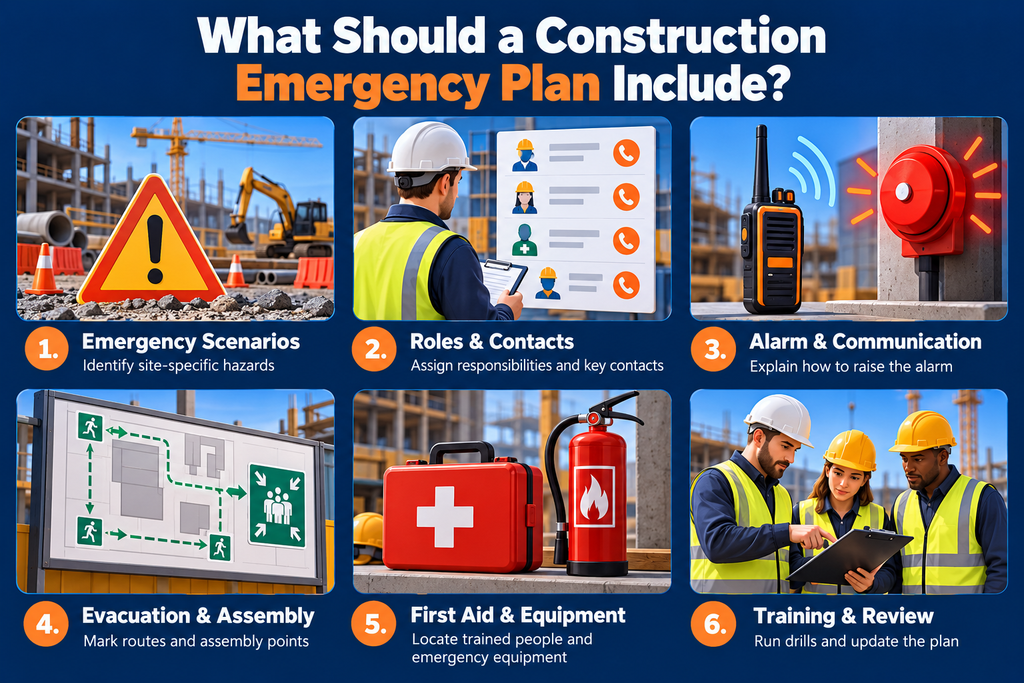
What Should a Construction Emergency Plan Include?
A construction emergency plan should be detailed enough to provide clear instructions but simple enough for people to use quickly.
The exact content will depend on the project, location, workforce, and risk profile. However, most construction emergency plans should include the following sections.
1. Project and Site Information
Start with basic information that helps identify the project and its location.
Include:
- Project name
- Site address
- Project manager
- Principal contractor
- Site manager
- Emergency coordinator
- Current project phase
- Site operating hours
- Number of workers
- Key subcontractors
- Emergency contact details
- Site access information
This information should be kept current because emergency responders may need accurate site details.
2. Emergency Contact Information
Emergency contact information should be easy to find.
Depending on the project, the list may include:
| Contact | Information to Include |
|---|---|
| Emergency services | Local emergency number |
| Site manager | Name and phone number |
| Project manager | Name and phone number |
| First aider | Name, location and contact |
| Health and safety/QSE lead | Name and phone number |
| Security | Contact information |
| Utility providers | Relevant emergency contacts |
| Client representative | Name and phone number |
| Building/facility management | Contact information |
| Specialist contractors | Emergency contact details |
Do not rely only on a digital contact list. Important emergency numbers should also be available on site.
3. Emergency Roles and Responsibilities
During an emergency, people need to know who is responsible for what.
Define roles such as:
- Emergency coordinator
- Site evacuation coordinator
- First aiders
- Fire wardens
- Traffic marshals
- Communication lead
- Muster point coordinator
- Security personnel
- Incident investigation team
For each role, explain the expected responsibilities.
For example, an evacuation coordinator may be responsible for:
- Initiating evacuation procedures
- Directing workers to designated assembly areas
- Coordinating with supervisors
- Supporting headcounts
- Reporting missing personnel
Clear responsibilities prevent multiple people from assuming that someone else is handling a critical task.
4. Emergency Scenarios and Response Procedures
A strong plan should address realistic emergency scenarios rather than simply providing generic instructions.
Depending on the project, consider:
Fire or Explosion
The plan should explain:
- How workers raise the alarm
- Evacuation procedures
- Fire equipment locations
- Emergency access routes
- Assembly points
- Headcount procedures
- Emergency service notification
- Rules for re-entering the site
Serious Injury or Medical Emergency
Include procedures for:
- Calling emergency medical services
- Providing first aid
- Securing the incident area
- Directing emergency responders
- Preserving relevant evidence
- Reporting the incident
- Managing access around the affected area
Chemical or Hazardous Material Spill
The procedure should identify:
- Spill response equipment
- Isolation requirements
- Evacuation requirements
- Personal protective equipment
- Reporting procedures
- Containment responsibilities
- Specialist response requirements
- Waste disposal procedures
Structural Collapse
A structural emergency requires immediate action.
The plan should cover:
- Immediate evacuation
- Establishing exclusion zones
- Preventing unauthorized entry
- Emergency service coordination
- Utility isolation where appropriate
- Search and rescue coordination
- Incident reporting
Severe Weather
Construction sites may face:
- High winds
- Flooding
- Lightning
- Extreme heat
- Heavy rainfall
- Snow or ice in relevant regions
Emergency procedures should define when work must stop and how workers will be moved to a safe location.
Equipment or Plant Failure
Consider emergencies involving:
- Cranes
- Excavators
- Forklifts
- Hoists
- Generators
- Temporary electrical equipment
- Lifting equipment
The plan should identify isolation procedures, exclusion zones, emergency contacts, and reporting requirements.
5. Evacuation Procedures
Workers should not have to figure out where to go during an emergency.
The emergency plan should identify:
- Primary evacuation routes
- Alternative routes
- Emergency exits
- Assembly points
- Accessible routes
- Restricted areas
- Site gates
- Emergency vehicle access
Because construction layouts change frequently, evacuation maps should be reviewed whenever site conditions change.
6. Muster Points and Headcounts
An assembly point is only useful if it is safe and accessible.
The plan should explain:
- Where workers should assemble.
- Who conducts the headcount.
- How subcontractors are accounted for.
- How visitors are identified.
- How missing people are reported.
- Who communicates the final headcount to emergency responders.
A common problem is maintaining separate attendance information across different contractors.
A centralized process can make this easier by keeping worker, contractor, visitor, and project information accessible to the responsible team.
7. Emergency Communication Procedures
Communication can become difficult during an emergency.
The plan should define:
- How an emergency is reported
- Who raises the alarm
- Who contacts emergency services
- How workers receive instructions
- Primary communication channels
- Backup communication methods
- Escalation procedures
- Client notification requirements
Avoid relying on a single communication method.
For example, if mobile phone coverage is unreliable, the project may need radios or another backup communication method.
8. First Aid and Medical Response
The emergency plan should identify:
- First aid locations
- First aiders
- First aid equipment
- Emergency access points
- Nearest medical facilities
- Ambulance access routes
- Procedures for serious injuries
The location of emergency equipment should also be communicated to workers during induction and toolbox talks.
9. Emergency Equipment
Document the location and availability of relevant equipment, such as:
- First aid kits
- Fire extinguishers
- Fire alarms
- Emergency lighting
- Spill kits
- Emergency showers
- Eye wash stations
- Rescue equipment
- Radios
- Emergency generators
- Personal protective equipment
However, listing equipment is not enough.
The project should also establish inspection and maintenance responsibilities.
10. Emergency Access and Site Logistics
Emergency responders need to reach the incident location quickly.
Therefore, the plan should identify:
- Emergency vehicle routes
- Site entrances
- Temporary roads
- Restricted areas
- Crane and plant locations
- Access gates
- Key access controls
- Utility shut-off locations
Construction teams should also ensure that emergency routes are not blocked by materials, vehicles, temporary structures, or stored equipment.
Construction Emergency Plan Checklist
Before approving an emergency plan, use the following checklist:
| Emergency Plan Element | Included? | Regularly Reviewed? |
|---|---|---|
| Site and project information | ✓ | ✓ |
| Emergency contacts | ✓ | ✓ |
| Emergency roles | ✓ | ✓ |
| Evacuation procedures | ✓ | ✓ |
| Muster points | ✓ | ✓ |
| Headcount procedures | ✓ | ✓ |
| Fire response | ✓ | ✓ |
| Medical response | ✓ | ✓ |
| Spill response | ✓ | ✓ |
| Severe weather response | ✓ | ✓ |
| Communication procedures | ✓ | ✓ |
| Emergency equipment | ✓ | ✓ |
| Emergency access routes | ✓ | ✓ |
| Site maps | ✓ | ✓ |
| Contractor procedures | ✓ | ✓ |
| Incident reporting | ✓ | ✓ |
| Recovery procedures | ✓ | ✓ |
This checklist can also be used during internal QSE inspections and project reviews.
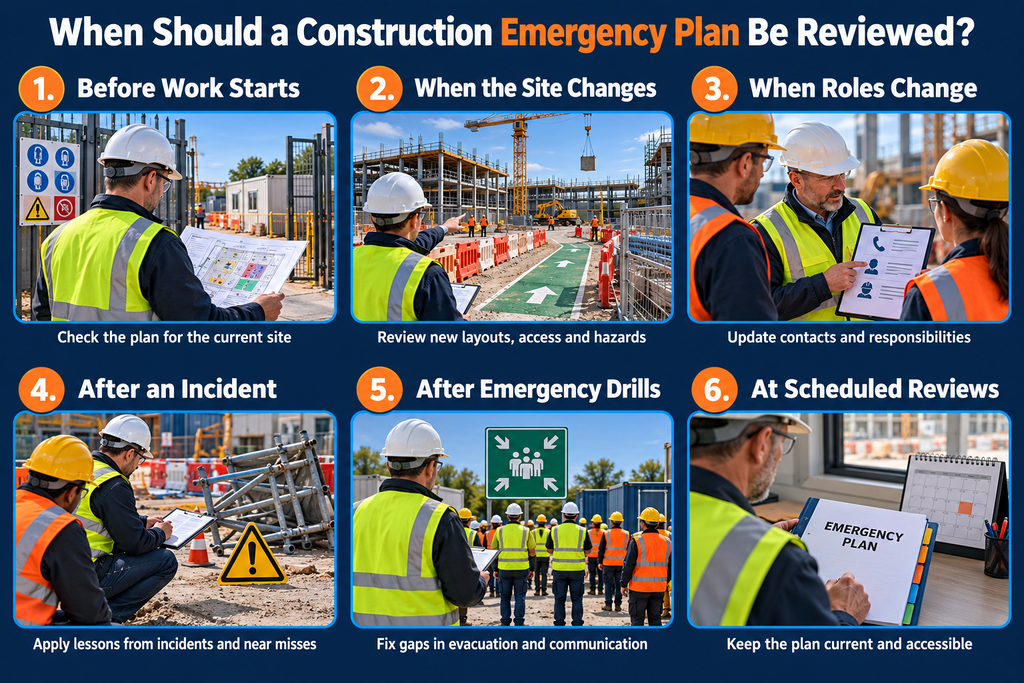
When Should a Construction Emergency Plan Be Reviewed?
There is no single review date that works for every construction project.
Instead, emergency plans should be reviewed regularly and whenever significant changes occur.
A good review schedule includes the following situations.
1. At the Start of the Project
Review the emergency plan before major site activities begin.
Confirm:
- Site layout
- Emergency routes
- Muster points
- Contact information
- Emergency equipment
- Worker responsibilities
- Project-specific hazards
2. After Major Site Changes
Construction sites evolve quickly.
Review the plan after:
- Site layout changes
- New buildings or structures
- New access routes
- Changes to site entrances
- Relocation of equipment
- Changes to storage areas
- Changes to temporary facilities
3. When New High-Risk Activities Begin
A new construction activity may introduce new emergency scenarios.
For example, starting hot work, excavation, confined-space work, lifting operations, or hazardous material handling may require updates to the emergency plan.
4. After an Incident or Near Miss
An emergency plan should be reviewed after a serious incident, emergency, or significant near miss.
Ask:
- Did the response work as expected?
- Did workers know what to do?
- Were emergency contacts correct?
- Was communication effective?
- Were evacuation routes practical?
- Were emergency resources available?
- Did contractors understand their responsibilities?
- What should be changed?
The objective is not simply to document what happened. It is to improve the response for the next event.
5. After an Emergency Drill
Emergency drills provide practical evidence about whether the plan works.
After a drill, record:
- Response time
- Evacuation time
- Attendance/headcount accuracy
- Communication issues
- Confusion or delays
- Equipment problems
- Worker feedback
- Corrective actions
Then update the plan based on what the drill revealed.
6. When Personnel or Contractors Change
Personnel changes can create gaps in emergency responsibilities.
Review the plan when:
- A site manager changes
- Emergency coordinators change
- First aiders change
- Fire wardens change
- Major subcontractors change
- New contractors join the project
7. During Scheduled QSE Reviews
Emergency planning should form part of routine construction QSE and health and safety reviews.
A practical approach is to include emergency planning within:
- Site inspections
- Internal audits
- Risk assessments
- Management reviews
- Contractor evaluations
- Toolbox talks
- Emergency drills
How Often Should Emergency Plans Be Reviewed?
A practical review frequency can look like this:
| Review Trigger | Recommended Action |
|---|---|
| Project commencement | Complete full review |
| Regular project review | Check current information and controls |
| Major site change | Review immediately |
| New high-risk activity | Review before work starts |
| New major contractor | Review relevant procedures |
| Emergency or serious incident | Review immediately |
| Near miss with emergency implications | Review relevant controls |
| Emergency drill | Review based on findings |
| Significant personnel change | Update responsibilities |
| Regulatory or client requirement changes | Review and update |
The key principle is simple: review the plan whenever the risks, people, site conditions, or emergency arrangements change.
Common Problems With Construction Emergency Plans
Many construction projects have emergency plans, yet those plans are not always effective.
Here are some common problems.
The Plan Is Too Generic
A generic emergency plan may mention fire, evacuation, and first aid but fail to address project-specific risks.
Better approach: Build the plan around the actual hazards and activities on the site.
Emergency Contacts Are Outdated
A phone number for a former site manager is not useful during an emergency.
Better approach: Include contact verification as part of regular QSE reviews.
Site Maps Are Outdated
An evacuation map showing an access route that no longer exists can create serious confusion.
Better approach: Update maps after significant site layout changes.
Contractors Are Not Included
Subcontractors may have their own procedures. However, those procedures still need to align with the project’s overall emergency arrangements.
Better approach: Include contractor responsibilities during induction and emergency drills.
The Plan Exists but Workers Do Not Know It
A document can be perfectly written and still fail if workers have never seen it.
Better approach: Communicate emergency procedures through inductions, toolbox talks, signage, and drills.
Corrective Actions Are Not Followed Up
Emergency drills and incidents often identify issues. Unfortunately, those issues can remain open if there is no effective corrective action process.
Better approach: Assign responsibility, set deadlines, and track closure.
How Technology Can Improve Construction Emergency Planning
Paper documents, spreadsheets, emails, and disconnected folders can make emergency information difficult to manage.
This becomes particularly challenging when multiple projects, sites, contractors, and QSE teams are involved.
A digital QSE management platform can help centralize:
- Emergency plans
- Risk assessments
- Site inspections
- Corrective actions
- Incident records
- Contractor information
- Evidence and photographs
- Documents
- Audit records
- Review dates
- Approval workflows
The goal is not simply to digitize paperwork. Instead, the goal is to make critical information easier to find, update, verify, and act on.
Managing Emergency Plans With Sky Soft Compliance
Sky Soft Compliance provides a digital approach to managing construction QSE and integrated management system processes.
Instead of keeping emergency documentation across separate spreadsheets, folders, forms, and email conversations, teams can use a centralized platform to manage important QSE information across projects and sites.
For construction teams, this can support workflows such as:
- Digital site forms
- Site inspections
- Risk assessments
- Corrective action management
- Evidence capture
- Contractor involvement
- Document management
- Project-level records
- Professional report generation
- Review and follow-up workflows
For example, if an emergency drill identifies an issue with an evacuation route, the finding can be recorded digitally, assigned to the responsible person, supported with evidence, and tracked through corrective action until closure.
This creates a more connected process:
Issue identified → Evidence captured → Corrective action assigned → Responsible person notified → Action completed → Evidence verified → Issue closed
That workflow can be much easier to manage than relying on separate spreadsheets and email chains.
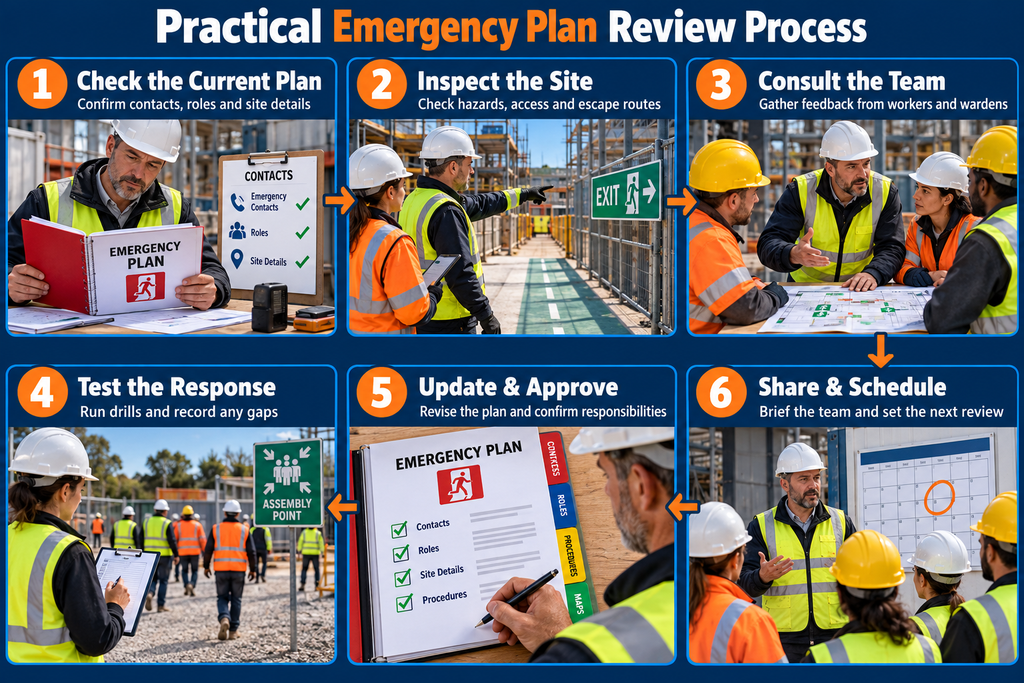
Practical Emergency Plan Review Process
Construction teams can use this five-step process to keep emergency plans current.
Step 1: Identify Changes
Before each review, ask:
- Has the site layout changed?
- Have new hazards been introduced?
- Have contractors changed?
- Have emergency contacts changed?
- Have access routes moved?
- Has new equipment been introduced?
- Have working hours changed?
Step 2: Check the Emergency Procedures
Review each major emergency scenario against current site conditions.
Do not simply approve the existing document. Confirm that the procedures still work in practice.
Step 3: Verify Resources
Check:
- Emergency equipment
- First aid facilities
- Fire equipment
- Spill response resources
- Communication equipment
- Emergency signage
- Muster points
- Site access routes
Step 4: Test the Plan
Use drills, inspections, and toolbox talks to identify practical problems.
Testing is important because a procedure that looks good on paper may not work efficiently on an active construction site.
Step 5: Record and Close Actions
Every identified issue should have:
- A clear description
- Responsible person
- Target completion date
- Supporting evidence
- Status
- Verification
- Closure record
This creates accountability and helps prevent the same issue from returning.
Frequently Asked Questions
A construction emergency plan should include emergency contacts, responsibilities, evacuation procedures, muster points, communication methods, first aid arrangements, emergency equipment, site access information, emergency scenarios, contractor responsibilities, and incident reporting procedures.
The plan should be reviewed regularly and whenever significant changes occur. This includes changes to site layout, activities, personnel, contractors, equipment, hazards, emergency routes, or after incidents and emergency drills.
Responsibility depends on the project’s organizational structure. However, the site manager, project manager, QSE/HSE team, emergency coordinator, and relevant supervisors commonly have defined responsibilities for maintaining and implementing emergency arrangements.
Yes. Subcontractors and their workers should understand the site’s emergency procedures, communication methods, evacuation arrangements, and responsibilities.
Final Takeaway
A construction emergency plan should do more than satisfy a compliance requirement.
It should give people clear instructions they can follow when time is limited and pressure is high.
The most effective approach is to:
- Identify realistic construction emergencies.
- Define clear roles and responsibilities.
- Maintain accurate emergency contacts.
- Keep evacuation routes and site maps current.
- Include contractors and visitors.
- Conduct emergency drills.
- Review plans after incidents and major changes.
- Track corrective actions to completion.
- Keep evidence of reviews, drills, and improvements.
- Use digital QSE workflows to make information easier to manage.
Most importantly, do not wait for an emergency to discover that your emergency plan is outdated.
A plan that is regularly reviewed, tested, communicated, and connected to your wider QSE processes gives construction teams a much stronger foundation for protecting people and responding effectively when something goes wrong.
With Sky Soft Compliance, construction teams can bring digital forms, inspections, evidence, corrective actions, reporting, and QSE workflows into one connected environment, helping turn emergency planning from a static document into an active part of site management.