
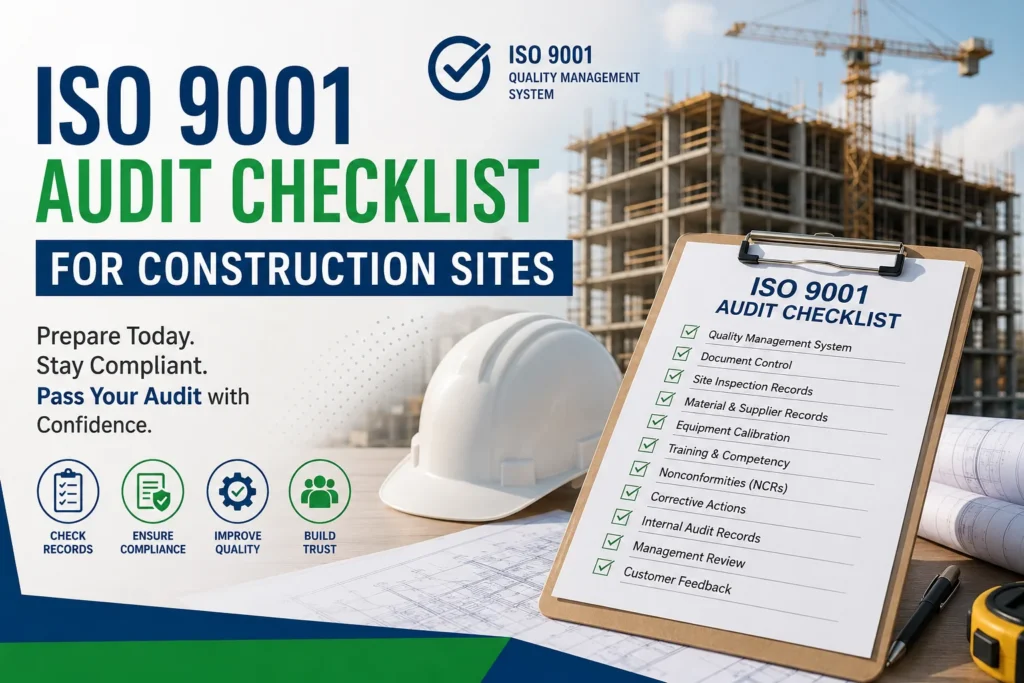
Preparing for an ISO 9001 audit can feel overwhelming, especially when construction site records are spread across spreadsheets, paper forms, emails, photos, and different project folders.
However, an audit does not have to become a last-minute document hunt.
A well-organized construction quality management system (QMS) gives your team a much better way to demonstrate that work is being planned, controlled, inspected, recorded, and improved. ISO 9001 focuses on areas such as documented information, operational control, performance evaluation, risk-based thinking, and continual improvement.
For construction companies, the key is simple: make sure your site records provide clear, traceable evidence that your processes are actually being followed.
This ISO 9001 audit checklist will help you review your construction site records before the auditor arrives.
What Is an ISO 9001 Audit?
An ISO 9001 audit evaluates whether an organization’s quality management system conforms to applicable ISO 9001 requirements and is effectively implemented.
In a construction environment, this can involve reviewing both management-system processes and practical evidence from project sites.
For example, an auditor may want to see evidence related to:
- Quality inspections
- Site checklists
- Inspection and Test Plans (ITPs)
- Nonconformance reports
- Corrective actions
- Material approvals
- Supplier and subcontractor evaluations
- Training and competency records
- Equipment inspections
- Project documentation
- Customer complaints and feedback
- Quality objectives and performance
- Internal audit results
- Management review actions
Importantly, an auditor is looking for objective, verifiable evidence. ISO’s auditing guidance notes that audit evidence can include records, statements of fact, and other information that can be verified against the audit criteria.
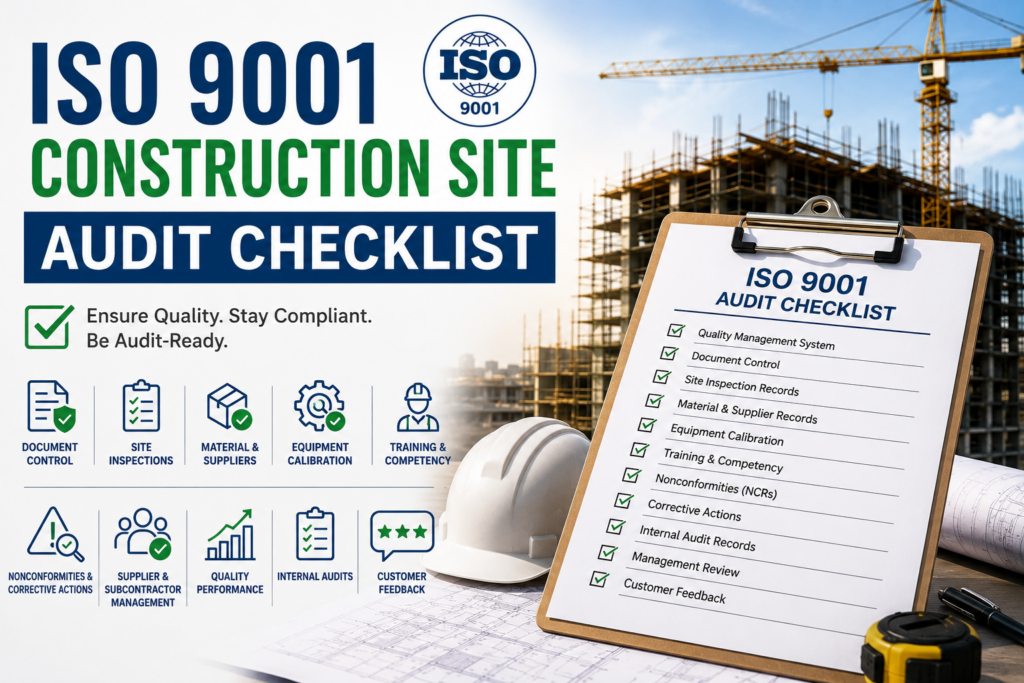
ISO 9001 Construction Site Audit Checklist
Before your next audit, review the following areas.
| Audit Area | Construction Records to Check | What to Verify |
|---|---|---|
| Quality Planning | Quality plans, ITPs, method statements | Current and approved |
| Site Inspections | Inspection checklists, reports | Completed and traceable |
| Materials | Material approvals, delivery records | Correct specifications |
| Equipment | Inspection and calibration records | Valid and up to date |
| Personnel | Training and competency records | Required qualifications available |
| Nonconformities | NCRs and corrective actions | Properly investigated and closed |
| Suppliers | Supplier evaluations | Approved and monitored |
| Subcontractors | Performance records | Requirements communicated |
| Documents | Procedures, drawings, specifications | Current revisions in use |
| Internal Audits | Audit reports and findings | Findings addressed |
| Customer Feedback | Complaints and feedback records | Actions documented |
| Quality Performance | KPIs and objectives | Results monitored and reviewed |
This checklist should be adapted to your company’s QMS, project requirements, contractual obligations, and applicable regulatory requirements.
1. Review Your Quality Management Documentation
Start with the foundation of your QMS.
Make sure your documented information is current, controlled, accessible, and relevant to the work being performed.
Check:
- Quality policy
- Quality objectives
- Quality manual, where applicable
- Quality plans
- Construction procedures
- Inspection and Test Plans
- Method statements
- Work instructions
- Project specifications
- Approved drawings
- Document control procedures
ISO guidance explains that documented information can exist in different formats and media. Therefore, construction companies do not necessarily need to rely on paper files. Electronic records, photographs, digital checklists, and other controlled formats can also form part of documented information.
Check Document Revisions
One common problem before an ISO audit is having outdated documents on site.
For every critical document, verify:
- The latest revision is available.
- Obsolete versions are controlled or removed.
- Approvals are recorded.
- Site personnel can access the correct information.
- Changes are properly communicated.
2. Make Construction Site Inspection Records Audit-Ready
Construction inspections are one of the most important sources of quality evidence.
Your records should make it easy to answer questions such as:
- What was inspected?
- When was it inspected?
- Where did the inspection take place?
- Who performed the inspection?
- What requirements were checked?
- What was the result?
- Were defects identified?
- What action was taken?
- Was the issue closed?
A good inspection record should therefore provide traceability from the requirement to the inspection result and, where necessary, the corrective action.
Review Your Inspection Checklists
Check that your site inspection checklists:
- Match current project requirements.
- Include appropriate acceptance criteria.
- Identify the relevant asset, location, or work activity.
- Record inspection dates.
- Identify the inspector.
- Capture findings and observations.
- Include supporting photographs where appropriate.
- Record corrective actions.
- Show closure status.
3. Check Nonconformance and Corrective Action Records
Finding a problem does not automatically mean your QMS is failing.
In fact, a mature quality system should identify problems and demonstrate how they were addressed.
Review your Non-Conformance Reports (NCRs) and corrective action records.
For each significant issue, check whether you have evidence of:
- The original problem
- Date and location
- Requirement that was not met
- Immediate correction
- Root cause analysis, where appropriate
- Corrective action
- Responsible person
- Target completion date
- Verification of effectiveness
- Final closure
Don’t Just Show That an NCR Was Closed
An auditor may look beyond the word “closed.”
They may want to understand whether the corrective action actually addressed the underlying cause and whether similar problems were prevented from recurring.
Therefore, connect your NCR records with inspection results, root-cause analysis, corrective actions, and follow-up verification wherever appropriate.
4. Verify Equipment Inspection and Calibration Records
Construction quality can depend heavily on measuring and monitoring equipment.
Before an ISO 9001 audit, review records for equipment such as:
- Measuring instruments
- Testing equipment
- Surveying equipment
- Pressure gauges
- Torque tools
- Inspection devices
- Calibration equipment
Check that records show:
- Equipment identification
- Calibration or verification status
- Due dates
- Calibration certificates
- Inspection history
- Any restrictions or conditions of use
If equipment is found to be out of calibration, make sure the organization has assessed whether previous inspection or measurement results could have been affected.
5. Review Material and Supplier Records
Materials are another important part of construction quality control.
Make sure you can trace important materials from delivery through inspection and, where required, approval and installation.
Review:
- Material approval requests
- Supplier documentation
- Certificates of conformity
- Test certificates
- Delivery records
- Material inspection reports
- Approved supplier lists
- Supplier performance evaluations
- Storage and handling records
Supplier Audit Checklist
Ask:
Is the supplier approved?
Were required specifications communicated?
Were delivered materials inspected?
Can the material be traced to the relevant project or work area?
Were supplier issues recorded and addressed?
This type of traceability makes it much easier to demonstrate effective operational control during an audit.
6. Check Training and Competency Records
ISO 9001 places importance on people performing work that can affect quality.
Therefore, review whether your construction workforce has appropriate evidence of competence.
Depending on the role, records may include:
- Induction records
- Training certificates
- Trade qualifications
- Competency assessments
- Toolbox talks
- Role-specific training
- Equipment operator qualifications
- Refresher training
- Training needs assessments
Also, make sure expired certifications or missing records are identified before the audit.
7. Verify Internal Audit Findings Are Closed
An internal audit should not become a document that simply sits in a folder.
Review previous internal audit reports and check whether findings were:
- Recorded clearly.
- Assigned to responsible people.
- Given appropriate deadlines.
- Investigated.
- Corrected where necessary.
- Verified for effectiveness.
- Properly closed.
ISO’s auditing guidance includes specific resources covering audit planning, evidence collection, nonconformity documentation, review and closure, and audit reports.
If your internal audit identified recurring issues, investigate why they continue to occur rather than simply marking each finding as complete.
8. Check Customer Complaints and Feedback
Customer feedback is valuable evidence for your quality management system.
Before the audit, review:
- Customer complaints
- Defect notifications
- Site instructions
- Client feedback
- Corrective actions
- Customer satisfaction information
- Lessons learned
Then ask:
Are recurring complaints being identified?
Are corrective actions documented?
Is management reviewing significant quality issues?
This helps demonstrate that your QMS is being used for continual improvement rather than simply for certification purposes.
9. Make Site Records Easy to Retrieve
One of the biggest challenges during an audit is not necessarily missing information.
Sometimes, the information exists but cannot be found quickly.
For example, an inspection record might be stored in:
Project Folder → Site → Inspections → Final → Revised → Old → New → Final 2
That is not an efficient audit trail.
Instead, construction companies should aim for a structured system where records can be searched by:
- Project
- Site
- Date
- Inspection type
- Asset
- Inspector
- Contractor
- Status
- Nonconformance
- Document number
Why Digital Record Management Helps
ISO guidance states that the extent of documented information can vary according to factors such as organizational size, process complexity, and competence.
Therefore, the goal is not to create unnecessary paperwork.
The goal is to maintain enough controlled information to demonstrate that processes are being effectively implemented.
How Sky Soft Compliance Can Help With ISO 9001 Audit Preparation
Preparing construction records manually can become difficult when projects, inspectors, subcontractors, and documents increase.
Sky Soft Compliance helps organizations move quality and compliance processes into a more structured digital environment.
Instead of relying entirely on spreadsheets, paper forms, and scattered folders, teams can use digital workflows to manage inspections, checklists, records, findings, and compliance activities.
With a centralized compliance system, your team can work toward:
- Digital inspection forms
- Standardized checklists
- Centralized compliance records
- Inspection history
- Corrective action tracking
- Nonconformance management
- Document control
- Audit preparation
- Evidence and record traceability
- Real-time visibility into outstanding actions
- Easier reporting and record retrieval
The biggest advantage is not simply “going digital.”
It is creating a consistent and traceable process for capturing quality evidence across construction projects.
ISO 9001 Audit Readiness: Quick 10-Point Check
Before the auditor arrives, ask your team these ten questions:
- Are our current quality procedures available?
- Are outdated documents controlled?
- Are construction inspections completed and traceable?
- Are ITPs and checklists aligned with project requirements?
- Are NCRs properly documented and closed?
- Are corrective actions tracked to completion?
- Are equipment calibration records current?
- Are supplier and material records complete?
- Are training and competency records up to date?
- Can we quickly retrieve objective evidence when an auditor asks for it?
If several answers are “no,” you still have time to address the gaps before the audit.
What Should a Construction Company Have Ready for an ISO 9001 Audit?
At a minimum, review the documented information and objective evidence relevant to your QMS and project activities.
Typical construction audit evidence includes:
Quality:
Quality plans, procedures, ITPs, inspection records, test results and quality objectives.
People:
Training, competency and qualification records.
Suppliers:
Approved supplier information, evaluations and material documentation.
Equipment:
Inspection, maintenance, calibration and verification records.
Nonconformities:
NCRs, root-cause investigations, corrective actions and closure evidence.
Performance:
Quality KPIs, customer feedback, internal audit results and management review outputs.
The exact evidence required will depend on your organization’s processes, QMS scope, project requirements and applicable ISO 9001 requirements.
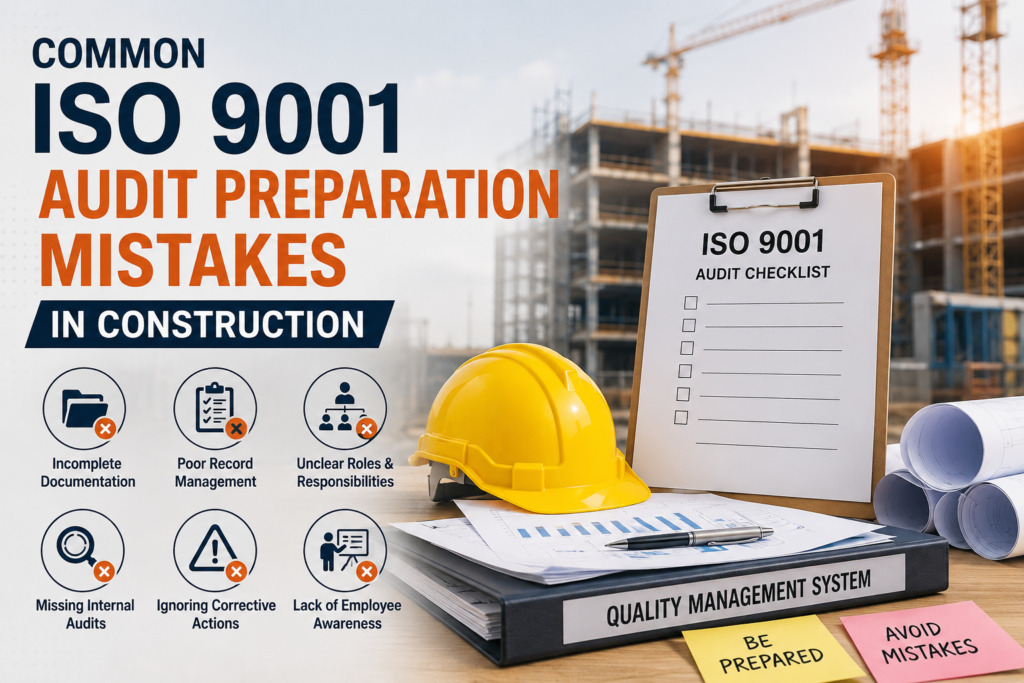
Common ISO 9001 Audit Preparation Mistakes in Construction
Even companies with a functioning QMS can struggle during an audit because of avoidable record-management problems.
1. Preparing Everything at the Last Minute
An audit should not trigger a sudden search for months of records.
Instead, maintain records continuously.
2. Using Outdated Checklists
A checklist may still look professional while containing old requirements.
Always verify revisions before use.
3. Closing Findings Without Evidence
Simply changing a status to “closed” is not enough. Keep evidence of the action and, where appropriate, effectiveness verification.
4. Keeping Records in Too Many Places
Scattered records make traceability difficult.
A centralized digital system can make retrieval considerably easier.
5. Focusing Only on Documents
ISO 9001 is about the effectiveness of the quality management system, not just producing paperwork. Auditors may examine how processes operate in practice and whether objective evidence supports conformity.
Final Thoughts: Make Your Construction Site Audit-Ready Every Day
The best time to prepare for an ISO 9001 audit is before you receive the audit notice.
When construction inspections, corrective actions, training, materials, equipment records, and quality documents are maintained consistently, audit preparation becomes much easier.
Rather than treating the audit as a one-time event, build an audit-ready quality culture where records are created, reviewed, controlled, and retrievable as part of normal project operations.
Digital compliance management can make this process even more efficient. With Sky Soft Compliance, construction teams can centralize quality and compliance activities, improve record traceability, and spend less time searching through spreadsheets and folders.
Ultimately, being ISO 9001 audit-ready is not about having the biggest stack of documents.
It is about having the right evidence, knowing where it is, and being able to demonstrate that your quality processes work.
Read more : A Practical Guide to Site Risk Assessments for Supervisors
Frequently Asked Questions About ISO 9001 Construction Audits
Common records include quality plans, inspection checklists, ITPs, test results, material records, equipment calibration certificates, training records, NCRs, corrective actions, supplier evaluations, internal audits, customer feedback and quality performance records.
Start by reviewing your documented information, inspection records, NCRs, corrective actions, equipment records, training records, supplier documentation and internal audit findings. Then verify that records are current, controlled, traceable and easy to retrieve.
An auditor may look for evidence that documented processes are actually being followed. This can include inspection records, work controls, competent personnel, equipment controls, nonconformance handling, material controls and evidence of continual improvement.
Yes. ISO guidance recognizes that documented information can be maintained in different formats and media, including electronic formats.
Compliance software can help centralize inspections, checklists, corrective actions, documents and audit evidence. This can improve traceability, standardization and record retrieval while reducing dependence on scattered spreadsheets and paper records.