Introduction
Safe Work Method Statements (SWMS) are an important part of managing high-risk construction work in Australia. However, creating a SWMS is only the beginning. Construction teams also need to make sure the document remains relevant, workers understand the controls, revisions are communicated and records can be accessed when required.
For many contractors, subcontractors and principal contractors, this becomes difficult when SWMS documents are spread across emails, shared drives, paper folders and individual project systems.
A better approach is to treat SWMS management as an ongoing process rather than a paperwork exercise.
Digital SWMS management can help construction businesses organise documents, track reviews, maintain version history and make important safety records easier to access.
Important: SWMS requirements can vary between Australian jurisdictions. This article provides general guidance based primarily on the model WHS framework. Construction businesses should always check the requirements of their relevant state or territory regulator.
What Is a SWMS?
A Safe Work Method Statement (SWMS) is a document that identifies high-risk construction work, the hazards associated with that work and the control measures that will be used to manage those risks.
Under the model WHS framework, a PCBU carrying out high-risk construction work has additional duties to prepare, keep, comply with and review a SWMS. The SWMS must be prepared before the high-risk construction work starts.
A SWMS typically connects:
- The work activity
- Potential hazards
- Risk controls
- Responsibilities
- Monitoring arrangements
- Review requirements
- Worker communication
Importantly, a SWMS should support the way work is actually performed. It should not simply become a document that workers sign and file away.
When Is a SWMS Required in Australia?
A SWMS is generally required when a construction activity meets the definition of high-risk construction work (HRCW) under the applicable WHS legislation.
Examples include work involving:
| High-risk activity | Example |
|---|---|
| Falls from height | Work where a person could fall more than 2 metres |
| Demolition | Demolition involving structural or load-bearing elements |
| Asbestos | Work that involves or may involve disturbing asbestos |
| Confined spaces | Construction work in or near a confined space |
| Excavation | Work in a shaft, trench or similar excavation |
| Powered mobile plant | Work involving risks from moving mobile plant |
| Traffic corridors | Construction work on or near certain roads or traffic areas |
| Structural work | Work involving temporary structural support |
The exact requirements depend on the applicable legislation and jurisdiction. Safe Work Australia identifies 18 categories of high-risk construction work under the model WHS framework.
Therefore, construction teams should identify HRCW before work begins, rather than creating a SWMS after an activity has already started.
What Should a SWMS Include?
A useful SWMS should clearly explain what work will be performed, what could go wrong and how the risks will be controlled.
Depending on the work and jurisdiction, key information can include:
- The high-risk construction activity
- Hazards associated with the activity
- Potential risks
- Control measures
- How controls will be implemented
- How controls will be monitored
- How controls will be reviewed
- Responsible people
- Relevant project and contractor information
For example, a SWMS for work at height should not simply state “use fall protection”. Instead, it should connect the activity, hazard, control and implementation process in a way workers can understand and follow.
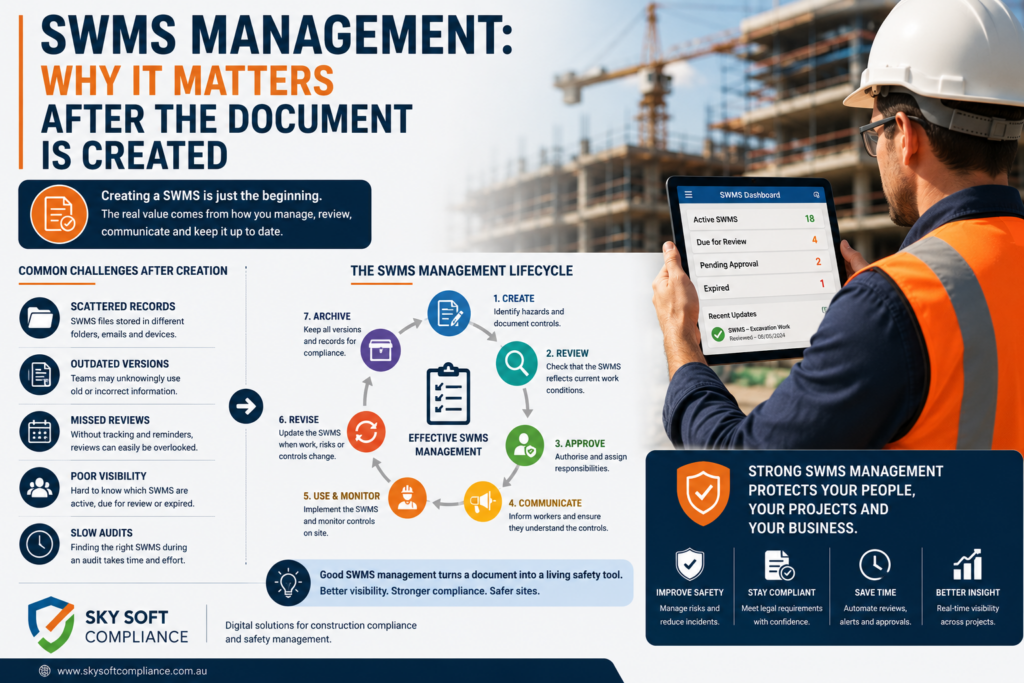
SWMS Management: Why It Matters After the Document Is Created
Creating hundreds of SWMS documents does not automatically create a strong safety management system.
The real challenge begins after the SWMS has been approved.
Construction teams may need to answer questions such as:
- Which SWMS applies to this project?
- Is the current version being used?
- When was it last reviewed?
- Who approved the latest revision?
- Were workers informed about the change?
- Has the work environment changed?
- Are the controls still effective?
- Can the record be produced during an audit?
If these answers require searching through multiple folders or asking several people, the business has a SWMS management problem.
Effective SWMS management should therefore cover the entire lifecycle:
Create → Review → Approve → Communicate → Use → Monitor → Revise → Archive
SWMS Review: When Should a SWMS Be Reviewed?
A SWMS should not remain unchanged simply because the document has already been approved.
Safe Work Australia states that where control measures are revised, the SWMS must be reviewed and revised as necessary. The review should also involve consultation with workers and relevant health and safety representatives.
A review may be necessary when:
- The work process changes
- Site conditions change
- New hazards appear
- Existing controls are no longer effective
- Plant or equipment changes
- The work sequence changes
- An incident or near miss identifies a weakness
- A control measure is changed
- Workers identify a new risk
- The project introduces a different working environment
For example, imagine a contractor initially prepares a SWMS for excavation work. Later, the excavation area changes and mobile plant begins operating closer to workers.
The original SWMS may no longer adequately reflect the actual site conditions.
That is when SWMS review becomes a practical safety requirement, not simply an administrative task.
What Happens When a SWMS Changes?
A revised SWMS should not simply replace the previous PDF.
The change needs to reach the people affected by it.
When a SWMS is revised, workers should be informed about the revision and how to access it. People whose work procedures or systems have changed should receive appropriate information and instruction.
A practical revision workflow looks like this:
Identify change → Review risk → Update controls → Approve revision → Notify workers → Implement → Record
This creates a stronger connection between documentation and actual site activity.
SWMS Version Control: Why It Is Important
One of the biggest weaknesses of manual SWMS management is version confusion.
Consider a project with:
- SWMS v1 stored on a laptop
- SWMS v2 sent by email
- SWMS v3 saved in SharePoint
- A printed copy on site
- Another copy attached to a contractor email
Which one is current?
Without proper version control, teams can unintentionally work from outdated information.
A digital SWMS system should make it clear:
| Record | What teams should know |
|---|---|
| Document | Which SWMS is being managed |
| Version | Current revision number |
| Date | When it was created or revised |
| Reviewer | Who reviewed it |
| Approval | Who authorised it |
| Status | Draft, active, revised or archived |
| Change history | What changed |
| Project | Where it applies |
| Workers | Who needs to be informed |
This creates a more reliable digital audit trail.
SWMS Record-Keeping Requirements
Keeping the SWMS is just as important as preparing it.
Under the model construction code, a SWMS must be kept and readily accessible while the relevant high-risk construction work is being carried out. If a notifiable incident occurs, the SWMS generally needs to be kept for at least two years following the incident. Revised versions should also be retained.
Queensland guidance similarly states that SWMS records should be kept until the high-risk construction work is completed, with additional retention requirements applying after a notifiable incident.
This makes record retention and accessibility an important part of construction compliance.
However, keeping a document does not necessarily mean keeping it well.
A strong record-keeping system should allow authorised users to quickly find:
- Current SWMS
- Previous versions
- Review dates
- Approval records
- Project information
- Worker acknowledgements
- Revision history
- Supporting evidence
Why Paper and Spreadsheet-Based SWMS Management Can Become Difficult
Paper records and spreadsheets can work for small projects. However, as construction operations grow, manual systems can become harder to maintain.
Common problems include:
Scattered records
Documents may exist across emails, laptops, folders and cloud storage.
Poor version control
Workers may accidentally access an outdated SWMS.
Missed reviews
Without automated reminders, review dates can easily be overlooked.
Slow audits
Finding historical documents can take hours when records are poorly organised.
Limited visibility
Managers may not have a clear view of which SWMS are active, expired, pending review or awaiting approval.
Weak change tracking
A revised document may exist without a clear record of what changed or who approved it.
As a result, the problem is not necessarily the SWMS itself. The problem is often the system used to manage the SWMS lifecycle.
How Digital SWMS Management Improves Construction Compliance
Digital construction compliance software can bring SWMS records into a centralised system.
Instead of relying on disconnected files, teams can manage documents according to projects, activities, contractors and review requirements.
A digital approach can help teams:
- Create and manage SWMS records
- Assign documents to projects
- Track document versions
- Record reviews and approvals
- Set review reminders
- Store supporting evidence
- Maintain historical records
- Improve document accessibility
- Reduce duplicate records
- Support audit preparation
More importantly, digital records can create a clearer connection between compliance activities and project operations.
Managing SWMS with Sky Soft Compliance
For Australian construction businesses looking to move beyond spreadsheets and scattered compliance documents, Sky Soft Compliance provides a digital approach to managing construction compliance information.
The platform can help organisations centralise compliance records and create a more structured process for managing safety documentation across projects and teams.
With a digital compliance workflow, teams can work towards better visibility over:
- SWMS documentation
- Reviews and revisions
- Compliance records
- Project documentation
- Responsibilities
- Evidence
- Audit history
Instead of asking, “Where did we save that SWMS?”, your team can work from a structured digital compliance environment.
This becomes especially valuable for businesses managing multiple projects, subcontractors and changing site conditions.
A Practical Digital SWMS Workflow for Construction Teams
A simple digital workflow can look like this:
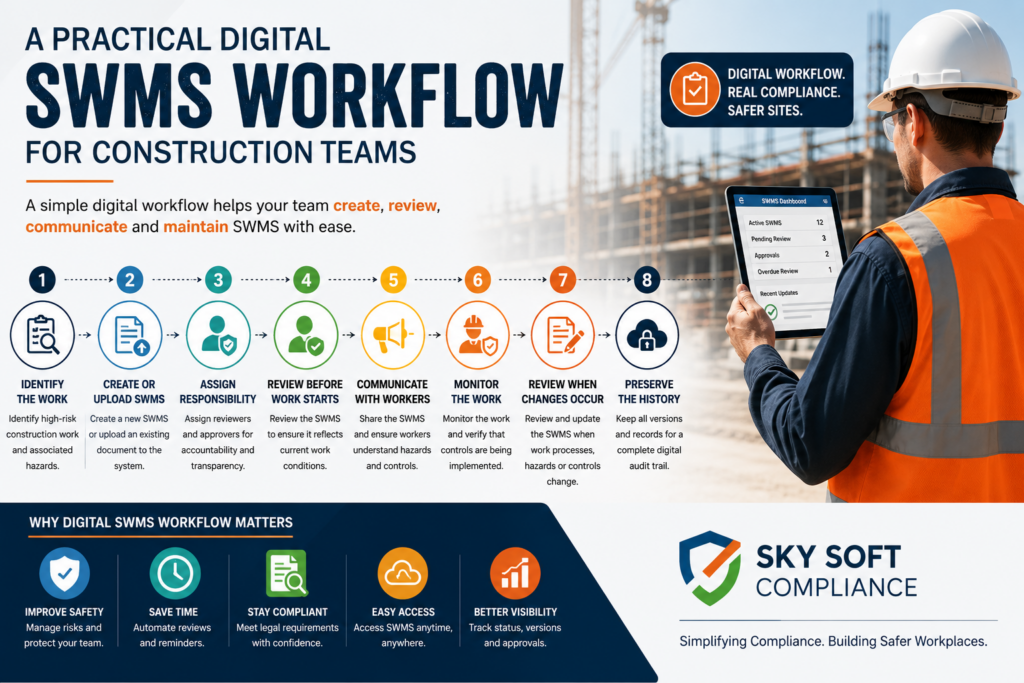
1. Identify the work
Determine whether the activity involves high-risk construction work.
2. Create or upload the SWMS
Record the relevant activity, hazards and control measures.
3. Assign responsibility
Identify who is responsible for reviewing, approving and implementing the SWMS.
4. Review before work starts
Confirm that the SWMS reflects the actual work environment and controls.
5. Communicate with workers
Make sure affected workers understand the hazards, controls and any relevant changes.
6. Monitor the work
Check that controls are actually being implemented.
7. Review when circumstances change
Update the SWMS when work processes, hazards or controls change.
8. Preserve the history
Keep previous versions and supporting records so the organisation has a reliable compliance history.
This approach turns SWMS from a static document into a managed safety record.
SWMS Management Checklist for Australian Construction Teams
Before starting high-risk construction work, teams should consider:
- Have we identified the relevant high-risk construction activities?
- Has the SWMS been prepared before work starts?
- Does it reflect the actual site conditions?
- Are hazards and risks clearly identified?
- Are appropriate control measures documented?
- Are responsibilities clearly assigned?
- Can workers access the relevant information?
- Has the SWMS been reviewed when conditions changed?
- Are revised versions retained?
- Can the team quickly retrieve historical records?
- Are review and approval activities documented?
- Can the business demonstrate its compliance history during an audit?
SWMS Management Is More Than Document Storage
A SWMS should not become a PDF that nobody opens after it receives an approval signature.
Its value comes from how effectively the organisation uses it to identify hazards, communicate controls and manage changes.
Safe Work Australia has highlighted concerns that SWMS are sometimes treated as unnecessary paperwork instead of being used as an important part of managing high-risk construction work.
Therefore, Australian construction teams should focus on how SWMS information is created, communicated, reviewed and maintained, not just whether a document exists.
Read more : Spot the warning signs your site isn’t audit-ready and learn how digital QSE tools keep you always prepared.
Frequently Asked Questions About SWMS Management
Under the model construction code, a SWMS should be kept and readily accessible until the relevant high-risk construction work is completed. Where a notifiable incident occurs, additional retention requirements apply, including keeping the SWMS for at least two years after the incident.
Yes. Safe Work Australia states that a SWMS can be kept electronically, provided it remains readily accessible as required.
A SWMS should be reviewed when relevant control measures change and should also be reviewed when work processes, site conditions or hazards change. Reviews should involve relevant workers and other affected duty holders where appropriate.
A SWMS can cover multiple high-risk construction activities where appropriate. However, the document must adequately address the activities, hazards and controls involved.
Not necessarily. A SWMS has a specific purpose under WHS requirements for high-risk construction work. It should not simply be treated as another generic safety procedure or risk assessment document.
Final Thoughts
Effective SWMS management in Australian construction is about more than creating compliant documents.
Construction teams need a reliable process for creating, reviewing, approving, communicating, updating and retaining SWMS records. As projects become more complex, manual folders and spreadsheets can make this process increasingly difficult.
A digital compliance system can provide better visibility, stronger version control and easier access to historical records.
Most importantly, it can help construction businesses move from document storage to active compliance management.
With platforms such as Sky Soft Compliance, construction teams can take a more structured approach to managing safety and compliance records across projects.
The goal is simple: make the right safety information available to the right people, at the right time, with a clear record of what changed and why.
Ready to improve your construction compliance workflow?
Explore how Sky Soft Compliance can help your team manage compliance records digitally, improve visibility and build a more organised approach to construction safety management.
Note: WHS requirements differ between Australian states and territories. Always confirm the requirements that apply to your specific project and jurisdiction with the relevant WHS regulator.