

An inspection identifies a problem, someone promises to fix it, and the project moves on. However, at the next site review, the same issue appears again.
The most damaging corrective action tracking mistakes involve unclear descriptions, missing owners, weak prioritisation and closure without verification. To avoid them, construction teams need a clear record of what went wrong, who will act, when they must finish and how they will prove the action worked.
Whether you manage quality defects, safety findings or environmental issues, the following improvements can strengthen your close-out process.
What Is Corrective Action Tracking in Construction?
Corrective action tracking means recording, assigning, monitoring and verifying actions that address the causes of identified problems. These problems may arise from site inspections, audits, incidents or non-conformance reports (NCRs).
A correction fixes the immediate problem; a corrective action addresses its cause to prevent recurrence. For example, replacing damaged materials resolves the defect, while improving storage arrangements may prevent further damage.
Therefore, an effective corrective action register should connect each finding to its cause, action owner, deadline, evidence and verification.
10 Corrective Action Tracking Mistakes and How to Fix Them
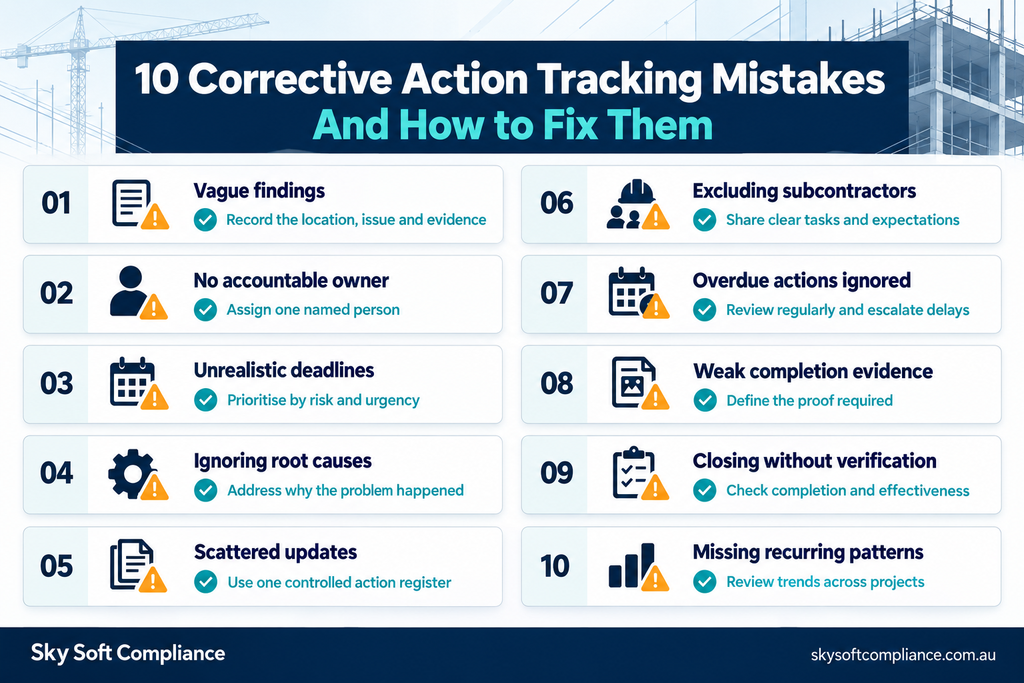
1. Recording Vague Findings
Entries such as “poor workmanship” give the next person little direction. As a result, teams may repair the wrong area or disagree about what satisfactory completion means.
How to fix it: Record the exact location, observed problem, relevant requirement and supporting evidence. For example, identify the room, drawing reference and specific defect instead of writing “fix bathroom tiling”.
2. Assigning Actions to a Team Instead of a Person
An action assigned to “the subcontractor” can pass between several people without clear accountability. Meanwhile, the site manager assumes someone has accepted responsibility.
How to fix it: Name one accountable owner and confirm they understand the task. In addition, identify who will verify completion so ownership and approval remain clear.
3. Setting Deadlines Without Considering Risk
Giving every finding the same deadline treats urgent hazards and minor documentation gaps alike. Consequently, teams may prioritise easy tasks while more serious issues remain unresolved.
How to fix it: Set priorities according to potential consequences and exposure. Where a finding presents immediate danger, take appropriate protective action at once; a future close-out date does not control today’s risk.
4. Fixing the Symptom Without Investigating the Cause
Repeatedly replacing damaged materials will not resolve unsuitable storage or handling practices. Similarly, repeating a toolbox talk may miss a problem with equipment, supervision or work planning.
How to fix it: Investigate why the issue occurred and use evidence to select the action. OSHA’s incident-investigation guidance also stresses addressing underlying causes when developing effective corrective actions. Occupational Safety and …
5. Scattering Updates Across Emails and Messages
A supervisor may receive completion photos through WhatsApp while the office keeps an outdated spreadsheet. As a result, nobody has a dependable view of outstanding work.
How to fix it: Maintain one controlled corrective action register and give each finding a unique reference. Then connect updates, documents and evidence to that record.
6. Leaving Subcontractors Out of the Process
Subcontractors cannot reliably complete actions when they lack the original finding, location details or acceptance criteria. However, forwarding an inspection report without identifying their responsibilities creates further confusion.
How to fix it: Share the specific action, deadline and evidence requirements with the responsible subcontractor. Also, confirm who will provide updates when their supervisor changes or their work package ends.
7. Waiting Until an Audit to Chase Overdue Actions
A register can look organised while overdue items remain untouched. Meanwhile, unresolved issues may pass into later construction stages and become harder to access.
How to fix it: Review open actions at a frequency that reflects their risk and urgency. If an action slips, record the reason, escalate it to the appropriate manager and retain the original deadline alongside any approved revision.
8. Accepting Weak Completion Evidence
A photo labelled “completed” may not show the correct location, repair detail or inspection result. Therefore, it may offer little support for a close-out decision.
How to fix it: Define acceptable evidence when assigning the action. Depending on the finding, require labelled photographs, test results, revised documents or an inspection record that demonstrates the specified outcome.
9. Closing Actions Without Checking Effectiveness
Completing a task does not automatically prove that it addressed the cause. For instance, issuing a revised procedure does not show whether crews understand and follow it.
How to fix it: Separate implementation from effectiveness verification. Then use a suitable follow-up inspection, observation or record review before final closure; reopen the action if the problem persists.
10. Ignoring Recurring Findings Across Sites
Reviewing each action in isolation can hide repeated failures across projects. Consequently, different teams may keep solving the same problem independently.
How to fix it: Review recurring findings by trade, location, supplier and cause. In addition, track overdue high-priority actions, reopened items and recurrence so management sees more than a total completion rate.
What Should a Corrective Action Register Include?
Use the following fields as a practical starting point. Together, they make each action easier to assign, review and trace.
| Register field | What to record |
|---|---|
| Finding reference | Unique ID linked to the inspection, audit or NCR |
| Location and issue | Project, work area and clear problem description |
| Cause and response | Identified cause, immediate correction and corrective action |
| Ownership | Named action owner and completion reviewer |
| Priority and deadline | Risk-based priority, due date and interim measures |
| Progress | Current status, blockers and escalation history |
| Evidence and verification | Completion records, effectiveness check and closure decision |
Before closing an action, check that:
- The owner completed the agreed work.
- The evidence matches the finding and location.
- The reviewer checked the acceptance criteria.
- The effectiveness check supports closure.
- The record retains the decision, reviewer and date.
How Sky Soft Compliance Software Can Help
Sky Soft Compliance software brings construction quality, safety and environmental processes into a digital environment. Its published information describes corrective action management, outstanding-task tracking, supporting documentation and organised compliance records.
For teams chasing updates across disconnected records, these capabilities can support a more consistent follow-up process. In addition, Sky Soft Compliance highlights visibility across multiple projects and sites, helping teams manage work across their portfolio.
Start by defining your ownership, evidence and approval rules. Then explore Sky Soft Compliance and request a walkthrough to discuss how your corrective action workflow fits the platform.
Read more : A Beginner’s Guide to SafeWork NSW Compliance Requirements
Frequently Asked Questions
A snag list typically records defects or unfinished work that need correction. Corrective action tracking goes further by addressing the underlying cause and checking whether the response prevents recurrence.
Assign ownership to a named person who has the authority and resources to coordinate completion. However, involve a suitably competent reviewer to assess the evidence and verify the outcome.
Close an action when the agreed work is complete, the evidence meets the acceptance criteria and verification shows the response is effective. If effectiveness needs time to assess, keep that follow-up visible rather than marking the whole action closed prematurely.
Build a Stronger Corrective Action Tracking Process
Effective corrective action tracking starts with clear findings, accountable owners and realistic deadlines. However, teams must also verify completion and check that each action addresses the underlying cause. Together, these steps help prevent recurring issues and keep construction records ready for review.
With Sky Soft Compliance software, construction teams can organise corrective actions, supporting evidence and outstanding tasks in a centralised platform. As a result, managers can follow up more consistently across projects.
Explore Sky Soft Compliance to bring greater clarity and accountability to your corrective action process.