
For construction companies operating in New South Wales, understanding SafeWork NSW compliance requirements is essential for maintaining a safe, organised and legally compliant workplace.
However, WHS compliance involves more than completing paperwork. Businesses must identify hazards, control risks, consult workers, provide appropriate training and maintain evidence that safety procedures are being followed.
This beginner’s guide explains the key SafeWork NSW requirements for construction companies and how digital compliance software can make safety management easier.
What Is SafeWork NSW Compliance?
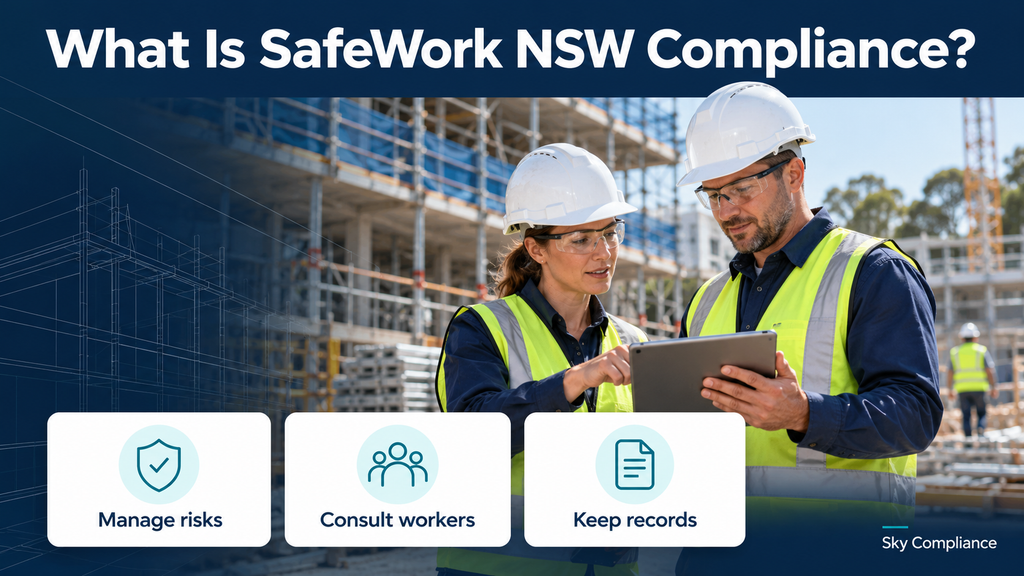
SafeWork NSW compliance refers to meeting the workplace health and safety obligations established under NSW Work Health and Safety (WHS) legislation.
These requirements apply to businesses, employers, workers, contractors and other duty holders, depending on their role and responsibilities.
In practical terms, compliance means your business should be able to demonstrate that it:
- Identifies workplace hazards
- Assesses and controls risks
- Provides worker training and supervision
- Consults workers about health and safety
- Maintains required safety documentation
- Manages incidents and emergencies
- Reviews safety controls when conditions change
For construction businesses, these responsibilities become particularly important because construction sites can involve working at heights, plant and equipment, excavation, hazardous substances and other high-risk activities.
Key SafeWork NSW Compliance Requirements
While requirements depend on the type of work and your organisation’s responsibilities, several areas are particularly important.
| Compliance area | What businesses should manage |
|---|---|
| Risk management | Identify hazards, assess risks and implement controls |
| SWMS | Prepare and implement SWMS for high-risk construction work |
| WHS management plan | Required for construction projects valued at $250,000 or more |
| Worker training | Provide appropriate information, training and instruction |
| Consultation | Consult workers about WHS matters |
| Site induction | Ensure workers receive relevant site safety information |
| Incident management | Report notifiable incidents and maintain records |
| Emergency planning | Prepare and maintain appropriate emergency procedures |
| Documentation | Keep safety records accessible and up to date |
The exact requirements depend on the work being performed, the risks involved and the duties of each person or organisation.
1. Understand Your WHS Duties
The first step is understanding who has responsibility for what.
A Person Conducting a Business or Undertaking (PCBU) has primary duties to ensure, so far as reasonably practicable, the health and safety of workers and other people affected by the work.
Businesses should therefore establish clear responsibilities for:
- Site managers
- Supervisors
- Workers
- Contractors
- Subcontractors
- Health and safety representatives
- Principal contractors
Furthermore, businesses must consult workers when they are directly affected by health and safety matters. Consultation should be ongoing rather than treated as a one-time activity.
2. Manage Workplace Risks
Effective risk management is at the centre of WHS compliance.
A simple process is:
Identify → Assess → Control → Monitor → Review
For example, a construction company may identify a fall hazard, assess the likelihood and potential consequences, implement appropriate controls and then monitor whether those controls remain effective.
The controls should also be reviewed when work conditions, equipment, processes or hazards change.
SafeWork NSW’s guidance emphasises the hierarchy of controls and the requirement to manage risks so far as reasonably practicable.
Common Construction Hazards
Construction companies may need to manage risks associated with:
- Falls from heights
- Moving plant and vehicles
- Excavation
- Electrical work
- Hazardous chemicals
- Manual handling
- Confined spaces
- Falling objects
- Noise and airborne contaminants
- Temporary structures
3. Prepare Safe Work Method Statements
A Safe Work Method Statement (SWMS) is required for high-risk construction work.
The SWMS should identify the high-risk work, associated hazards and risks, control measures, and how those controls will be implemented, monitored and reviewed.
Importantly, a SWMS should be site-specific and available to workers and supervisors.
If conditions change, the SWMS should also be reviewed and updated.
4. Understand WHS Management Plans
For construction projects valued at $250,000 or more, a principal contractor must oversee the project and prepare a WHS management plan before construction work begins.
The plan should address areas such as:
- WHS responsibilities
- Worker consultation
- Site safety rules
- Incident arrangements
- Communication procedures
- SWMS management
- Monitoring and review processes
The plan must also remain accessible and be kept up to date.
5. Provide Training and Site Inductions
Workers need appropriate information, instruction, training and supervision to perform their work safely.
For construction work, workers generally need a general construction induction card, commonly called a White Card.
Businesses should also maintain evidence of:
- Worker qualifications
- Training records
- Site inductions
- Toolbox talks
- Competency checks
- Refresher training
Keeping these records digitally can make it much easier to demonstrate compliance during audits or inspections.
6. Report Notifiable Incidents
Some workplace incidents must be reported to SafeWork NSW immediately.
These include certain:
- Serious injuries or illnesses
- Deaths
- Dangerous incidents
SafeWork NSW states that notifiable incidents should be reported immediately, including by calling 13 10 50.
Businesses should therefore have a clear incident reporting process so workers know what to do when an incident occurs.
7. Keep Compliance Records Organised
Compliance becomes difficult when safety information is scattered across spreadsheets, emails, paper forms and different folders.
A practical compliance system should help businesses manage:
- Risk assessments
- Inspections
- Incident reports
- Corrective actions
- Training records
- Worker competencies
- SWMS
- Site inductions
- Audit records
- Safety documentation
Consequently, having a centralised system can make compliance information easier to find, review and demonstrate.
What Changed for SafeWork NSW Compliance in 2026?
An important change took effect on 1 July 2026.
Under section 26A of the NSW WHS Act, duty holders are required to comply with approved Codes of Practice or manage hazards and risks using another method that provides an equivalent or higher standard of health and safety.
This makes keeping up with relevant Codes of Practice even more important for NSW businesses.
Companies should regularly review applicable Codes, safety procedures and risk controls rather than relying on outdated documentation.
How Can Compliance Software Help?
Managing WHS compliance manually can become time-consuming as a construction business grows.
Sky Compliance helps businesses organise compliance activities digitally, reducing reliance on disconnected paperwork and spreadsheets.
With a centralised compliance system, teams can manage areas such as:
- Digital inspections and checklists
- Risk assessments
- Corrective actions
- Incident reporting
- Compliance records
- Worker documentation
- Audit evidence
- Safety documentation
- Inspection history
Instead of searching through multiple files, managers can have important compliance information organised in one place.
SafeWork NSW Compliance Checklist
Before considering your WHS system ready, review whether your business can answer yes to these questions:
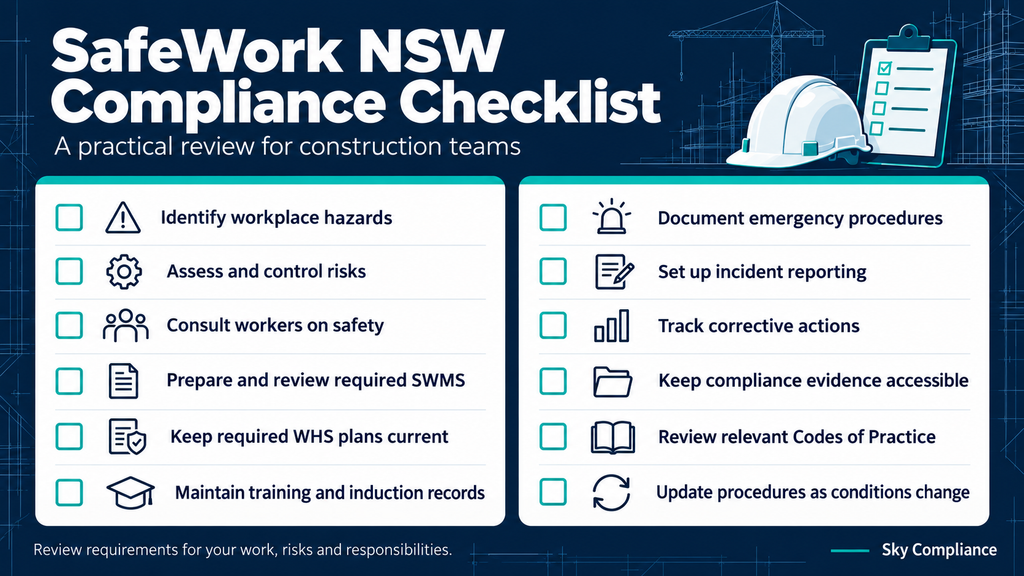
- Are workplace hazards identified?
- Are risks assessed and controlled?
- Are workers consulted about WHS matters?
- Are required SWMS prepared and reviewed?
- Is your WHS management plan current where required?
- Are worker training and induction records maintained?
- Are emergency procedures documented?
- Is there a clear incident reporting process?
- Are corrective actions tracked to completion?
- Can you quickly provide evidence of compliance?
- Are relevant SafeWork NSW Codes of Practice reviewed?
- Are safety procedures updated when conditions change?
Read more : Digital vs Paper Forms: Why Construction Companies Are Switching
Frequently Asked Questions
SafeWork NSW compliance means meeting applicable NSW workplace health and safety duties and demonstrating that hazards and risks are being properly managed.
No. A SWMS is required for high-risk construction work. The SWMS must address the relevant high-risk activities and be implemented and reviewed appropriately.
For construction projects valued at $250,000 or more, the principal contractor must prepare a WHS management plan before construction work starts.
Generally, people carrying out construction work need a general construction induction card, commonly known as a White Card.
Compliance software can centralise inspections, risk assessments, incidents, corrective actions, training records and supporting evidence, making safety management more organised and easier to monitor.
Final Thoughts
SafeWork NSW compliance does not have to become a paperwork-heavy process.
By combining risk management, worker consultation, appropriate training, effective documentation, incident management and regular reviews, construction businesses can build a more organised WHS system.
Most importantly, compliance should be treated as an ongoing process. As work conditions and regulations change, your safety procedures and records should change with them.
For businesses looking to simplify this process, Sky Compliance provides a digital approach to managing inspections, compliance records, risks and safety documentation in one place.