
Construction quality cannot be left to the final inspection. From materials and workmanship to testing and approvals, every stage of a construction project needs to be checked and documented.
This is where an Inspection and Test Plan (ITP) becomes valuable.
An ITP provides a structured way to define what needs to be inspected, when inspections should take place, which tests are required, who is responsible, and what evidence must be recorded.
For construction companies, a well-managed ITP can improve quality control, reduce rework, support compliance, and create a reliable record of completed work.
What Is an Inspection and Test Plan (ITP)?
An Inspection and Test Plan (ITP) is a quality control document used in construction to identify the inspections, tests, approvals, and quality checks required throughout a project.
It is normally prepared around specific construction activities or work packages. For example, an ITP for concrete works may cover reinforcement inspection, formwork checks, concrete placement, curing, and testing.
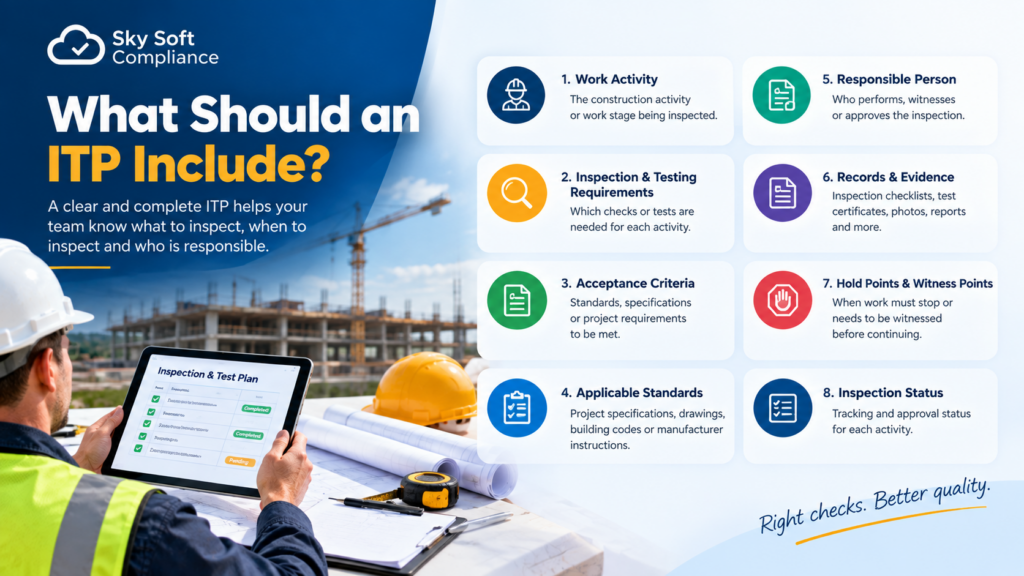
An ITP typically identifies:
- Construction activity or work stage
- Inspection or testing requirement
- Applicable specification or standard
- Acceptance criteria
- Person responsible for the inspection
- Required records and evidence
- Hold points and witness points
- Inspection status and approval
Therefore, an ITP acts as a practical roadmap for construction quality assurance.
Why Are ITPs Important in Construction?
Construction projects involve multiple contractors, suppliers, engineers, inspectors, and site teams. Without a structured inspection process, important quality checks can easily be missed.
An ITP helps establish clear quality requirements before work begins.
For example, instead of discovering a problem after concrete has been poured, the inspection process can require reinforcement and formwork to be checked and approved beforehand.
This approach helps construction teams move from reactive quality control to more proactive quality management.
Key Benefits of ITPs
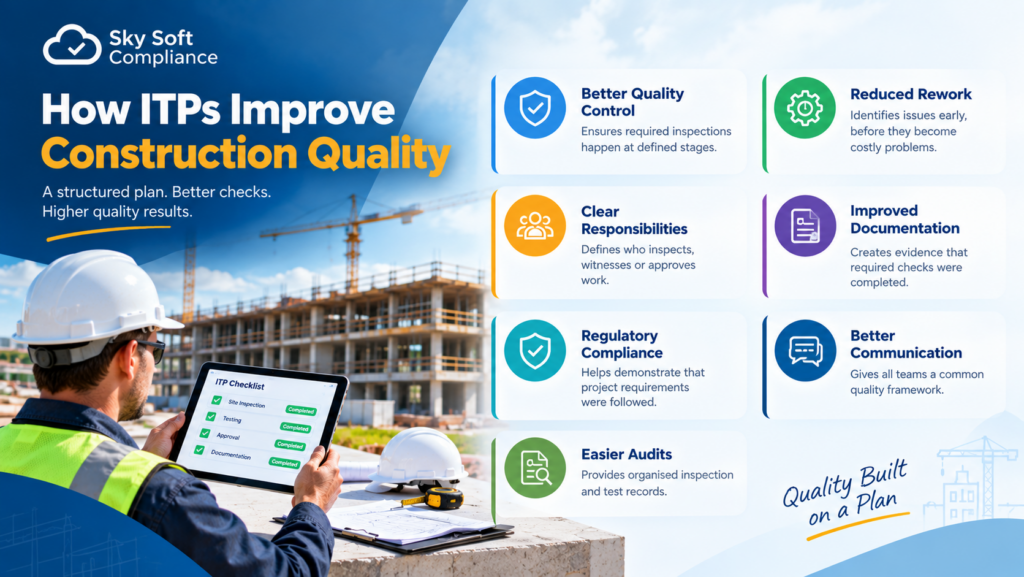
| Benefit | How It Helps Construction Projects |
|---|---|
| Better quality control | Ensures required inspections happen at defined stages |
| Reduced rework | Problems can be identified before they become expensive |
| Clear responsibilities | Defines who performs, witnesses, or approves inspections |
| Improved documentation | Creates evidence that required checks were completed |
| Regulatory compliance | Helps demonstrate that project requirements were followed |
| Better communication | Gives contractors and inspectors a common quality framework |
| Easier audits | Provides organised inspection and test records |
What Should an ITP Include?
Although ITP formats vary between projects, a good Inspection and Test Plan should provide enough information for site teams to understand exactly what needs to happen.
1. Work Activity
The ITP should clearly identify the construction activity being inspected.
Examples include:
- Excavation and earthworks
- Concrete works
- Structural steel installation
- Waterproofing
- Mechanical installation
- Electrical installation
- Welding and fabrication
- Coating and painting
2. Inspection and Testing Requirements
The plan should explain which checks or tests are required for each activity.
For example, concrete works may require checks for reinforcement, formwork, concrete temperature, slump, sampling, and compressive strength.
3. Acceptance Criteria
Inspection results need to be compared against clearly defined requirements.
These may come from:
- Project specifications
- Approved drawings
- Building regulations
- Engineering requirements
- Manufacturer instructions
- Applicable standards
- Contract requirements
Clear acceptance criteria make it easier for inspectors to determine whether work is acceptable.
4. Hold Points and Witness Points
ITPs often include hold points and witness points.
A hold point means work should not proceed until the required inspection or approval has been completed.
A witness point gives an authorised person the opportunity to witness an inspection or test. Depending on the project requirements, work may proceed if the inspection is not attended.
These controls are particularly important for activities that become difficult or impossible to inspect after the next construction stage begins.
5. Records and Evidence
Inspection results should be supported by appropriate evidence.
This may include:
- Inspection checklists
- Test certificates
- Photographs
- Material certificates
- Survey records
- Laboratory reports
- Sign-offs
- Non-conformance records
Consequently, the ITP becomes more than a checklist. It becomes part of the project’s quality evidence.
How ITPs Improve Construction Quality
1. They Identify Quality Requirements Before Work Starts
One of the biggest advantages of an ITP is that quality requirements are established before construction activities take place.
The project team can identify critical inspection stages in advance. As a result, site personnel know what needs to be checked instead of relying on assumptions.
2. They Reduce Construction Rework
Rework can increase labour costs, delay schedules, and create additional material waste.
An ITP helps identify defects earlier.
For example, checking embedded items before concrete placement can prevent costly corrective work later.
Therefore, early inspection can protect both project quality and project efficiency.
3. They Create Clear Accountability
Quality problems can become difficult to investigate when responsibilities are unclear.
An ITP can identify who is responsible for:
- Performing an inspection
- Reviewing results
- Witnessing a test
- Approving completed work
- Maintaining inspection records
This creates a clearer quality management process across contractors and project teams.
4. They Improve Construction Documentation
Modern construction projects generate large volumes of quality information.
Without a structured system, inspection records can become scattered across spreadsheets, emails, paper forms, and shared folders.
A well-managed ITP connects inspections with the relevant work activity and supporting evidence.
This makes information easier to retrieve when it is needed for project reviews or audits.
5. They Support Compliance and Audits
Construction companies may need to demonstrate that work was completed according to contractual, regulatory, and quality requirements.
A properly maintained ITP provides documented evidence of inspections and testing.
Furthermore, organised inspection records can make internal and external audits easier because the required evidence can be located more quickly.
ITP vs QA/QC: What Is the Difference?
ITPs are often discussed alongside Quality Assurance (QA) and Quality Control (QC). However, they are not exactly the same.
| Term | Purpose |
|---|---|
| Quality Assurance (QA) | Establishes processes that help ensure quality requirements are consistently followed |
| Quality Control (QC) | Checks whether completed or ongoing work meets specified requirements |
| Inspection and Test Plan (ITP) | Defines the inspections, tests, responsibilities, and acceptance requirements for specific work activities |
In simple terms, QA focuses on the system, QC focuses on checking the work, and the ITP provides a structured plan for those checks and tests.
Common ITP Mistakes Construction Companies Should Avoid
An ITP is only useful when it is properly prepared and maintained.
Common mistakes include:
Using Generic ITP Templates
A generic template may not reflect the actual requirements of a specific project.
ITPs should be aligned with project drawings, specifications, construction methods, risks, and contractual requirements.
Unclear Acceptance Criteria
If an inspector does not know what constitutes an acceptable result, the inspection becomes subjective.
Acceptance criteria should be specific and measurable wherever possible.
Missing Hold Points
Critical activities may require approval before work continues. Missing these points can create significant quality risks.
Poor Record Management
Even when inspections are completed correctly, poor documentation can make it difficult to prove that they happened.
Treating the ITP as a Static Document
Construction projects change. Drawings, specifications, methods, and responsibilities can also change.
Therefore, ITPs should be reviewed and updated when project requirements change.
How Construction Software Can Improve ITP Management
Traditional ITP management often relies on paper forms, spreadsheets, emails, and shared folders. While these methods can work for small projects, they can become difficult to manage as project complexity increases.
Digital construction compliance software can help centralise inspection activities and quality records.
For example, Sky Soft Compliance Software can support construction teams by bringing compliance and inspection information into a more structured digital environment.
Instead of relying entirely on disconnected documents, teams can manage inspection-related information more systematically and maintain better visibility over project compliance activities.
Digital workflows can help teams:
- Standardise inspection processes
- Record inspection results digitally
- Maintain supporting evidence
- Track outstanding actions
- Improve document organisation
- Reduce reliance on paper records
- Make compliance information easier to access
- Support audit preparation
The objective is not simply to replace paper with software. More importantly, digital compliance management can help create a consistent and traceable quality process.
Best Practices for Creating Effective ITPs
To get the most value from an Inspection and Test Plan, construction teams should:
- Start with the project specification and approved drawings.
- Identify critical inspection and testing stages.
- Define measurable acceptance criteria.
- Clearly assign inspection responsibilities.
- Identify hold and witness points.
- Specify the evidence that must be retained.
- Keep inspection records linked to the relevant work activity.
- Review ITPs when project requirements change.
- Make inspection information accessible to relevant site personnel.
- Use digital systems where project size and complexity justify them.
Read more : Compliance Inspections Software for Construction
Frequently Asked Questions About Inspection and Test Plans
The main purpose of an ITP is to define the inspections, tests, acceptance criteria, responsibilities, and evidence required to verify that construction work meets specified quality requirements.
An ITP is generally prepared by the contractor or project quality team, with input from relevant engineers, consultants, subcontractors, and client representatives where required.
Not necessarily. The level of inspection and documentation should reflect the project’s requirements, specifications, risks, and contractual obligations. Critical or high-risk activities generally require more detailed inspection controls.
A hold point normally requires approval before work can continue. A witness point provides an opportunity for an authorised party to witness an inspection or test, subject to the project’s agreed procedures.
Yes. Digital construction compliance platforms can help teams create, manage, track, and retain inspection records while improving access to quality and compliance information.
Final Thoughts
An effective Inspection and Test Plan is an important part of construction quality management. By defining inspection stages, responsibilities, acceptance criteria, testing requirements, and evidence in advance, ITPs help construction teams identify problems earlier and maintain better control over quality.
However, creating an ITP is only the beginning. The real value comes from consistently completing inspections, recording evidence, addressing issues, and maintaining reliable project records.
As construction projects become more complex, digital construction compliance solutions such as Sky Soft Compliance Software can help teams move beyond scattered paperwork and create a more organised approach to inspections, quality, and compliance.
When inspection requirements are clearly planned and properly documented, construction teams have a stronger foundation for delivering consistent quality and maintaining reliable project records.